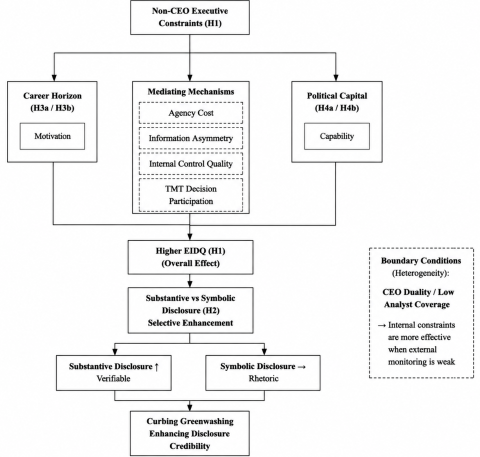
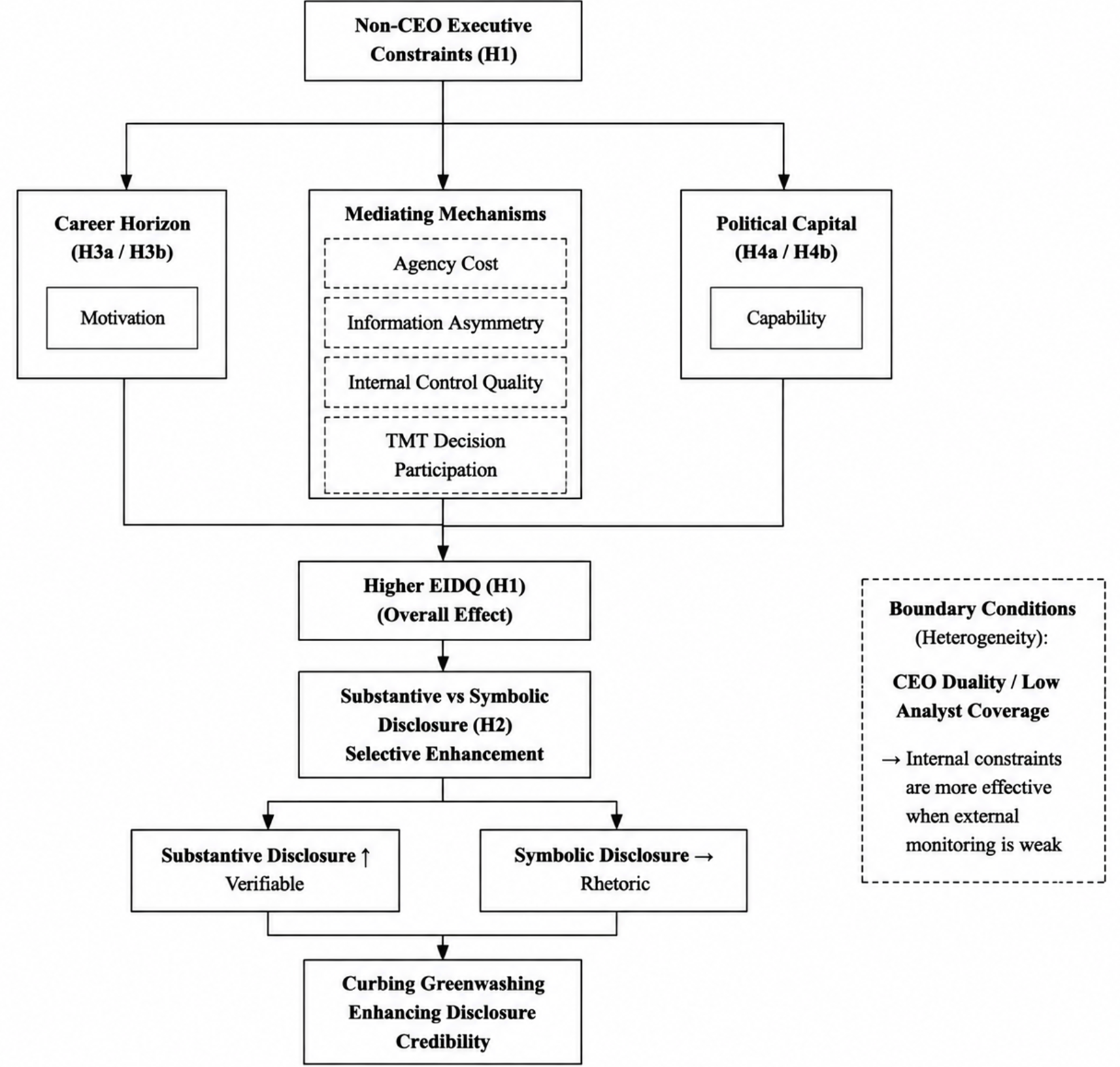
This study, grounded in Veto Player Theory and Upper Echelons Theory, investigates whether non-CEO executives can curb CEO opportunism in environmental disclosures by leveraging their information advantage. Using a sample of Chinese A-share listed companies from 2007 to 2024, we employ IPO-stage equity structure as an instrumental variable, complemented by PDS-Lasso and random forest methods for robustness checks. The findings reveal that the check-and-balance mechanism of non-CEO executives fundamentally reshapes disclosure composition: substantive, verifiable hard information (Sub_EIDQ) increases significantly, while symbolic disclosure (Sym_EIDQ) shows no meaningful change. This “selective enhancement” pattern directly targets the core concern of greenwashing. However, the effectiveness of such constraints depends on two conditions: non-CEO executives must possess both the motivation (career horizon) and the capability (political capital) to challenge the CEO. Mechanism tests demonstrate that internal constraints improve environmental information disclosure quality through four complementary pathways: reducing agency costs, alleviating information asymmetry, strengthening internal controls, and enhancing TMT decision-making participation. Heterogeneity analysis further reveals that this positive effect of non-CEO executive constraints on disclosure quality is more pronounced when external supervision is weak, confirming a substitution effect whereby internal governance compensates for deficiencies in external monitoring. Overall, this study uncovers the micro-political foundations of sustainable reporting and illustrates how internal power balance transforms corporate disclosures from mere rhetoric to substantive content.