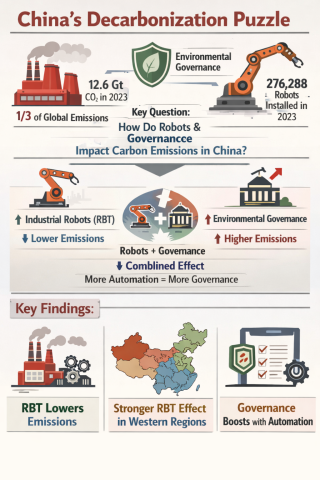
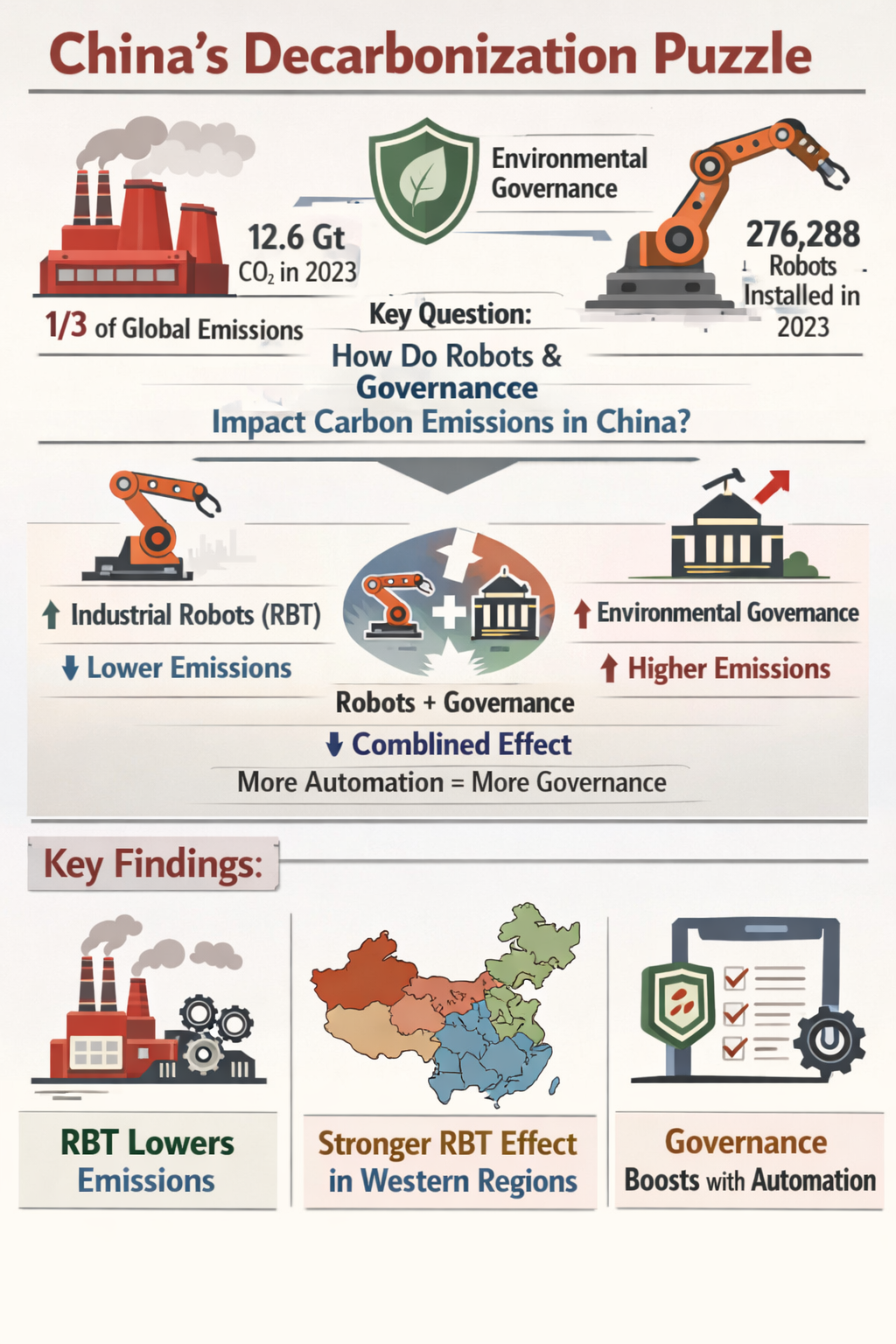
China’s decarbonization puzzle is stark: energy-related CO₂ emissions climbed to about 12.6 Gt in 2023—roughly one-third of the global total—even as industrial automation surged, with 276,288 robots installed that year, the most worldwide. In parallel, environmental governance has been emerged as the key factor to influence the carbon emissions in China. These cross-currents motivate our central question: how do industrial robotic penetration (RBT) and governance efforts, separately and jointly, influence China’s provincial carbon trajectories? Using panel data for 30 provinces (2007–2022), we conduct pre-diagnostics for cross-sectional dependence, slope heterogeneity, and serial correlation, then estimate Feasible GLS models as main estimation approach. The baseline results show that higher RBT is associated with lower emissions, consistent with process upgrading and energy-efficient production. By contrast, environmental governance correlates positively with emissions in linear specifications, indicating that governance metrics often scale with high-pressure contexts. The interaction term of industrial robotic penetration and environmental governance is positive, suggesting that governance attention increases where automation uptake is already responding to tougher environmental conditions. Robustness using Prais–Winsten confirms the signs and significance. Heterogeneity analysis reveals a stronger abatement effect of RBT in western regions—where scale effects are smaller and upgrading is earlier—and a weaker effect in the combined central–eastern group with dense industrial ecosystems. Policy implications are threefold: prioritize automation-led efficiency where marginal gains are largest; align governance with technology adoption and energy management rather than inputs alone; and differentiate regional pathways to synchronize industrial upgrading with decarbonization.