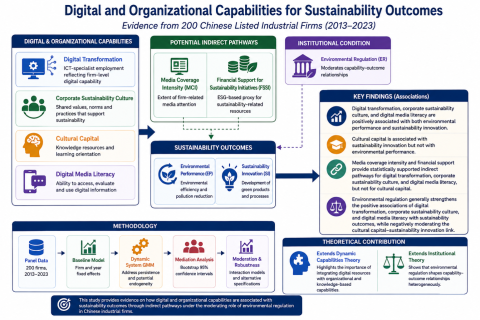
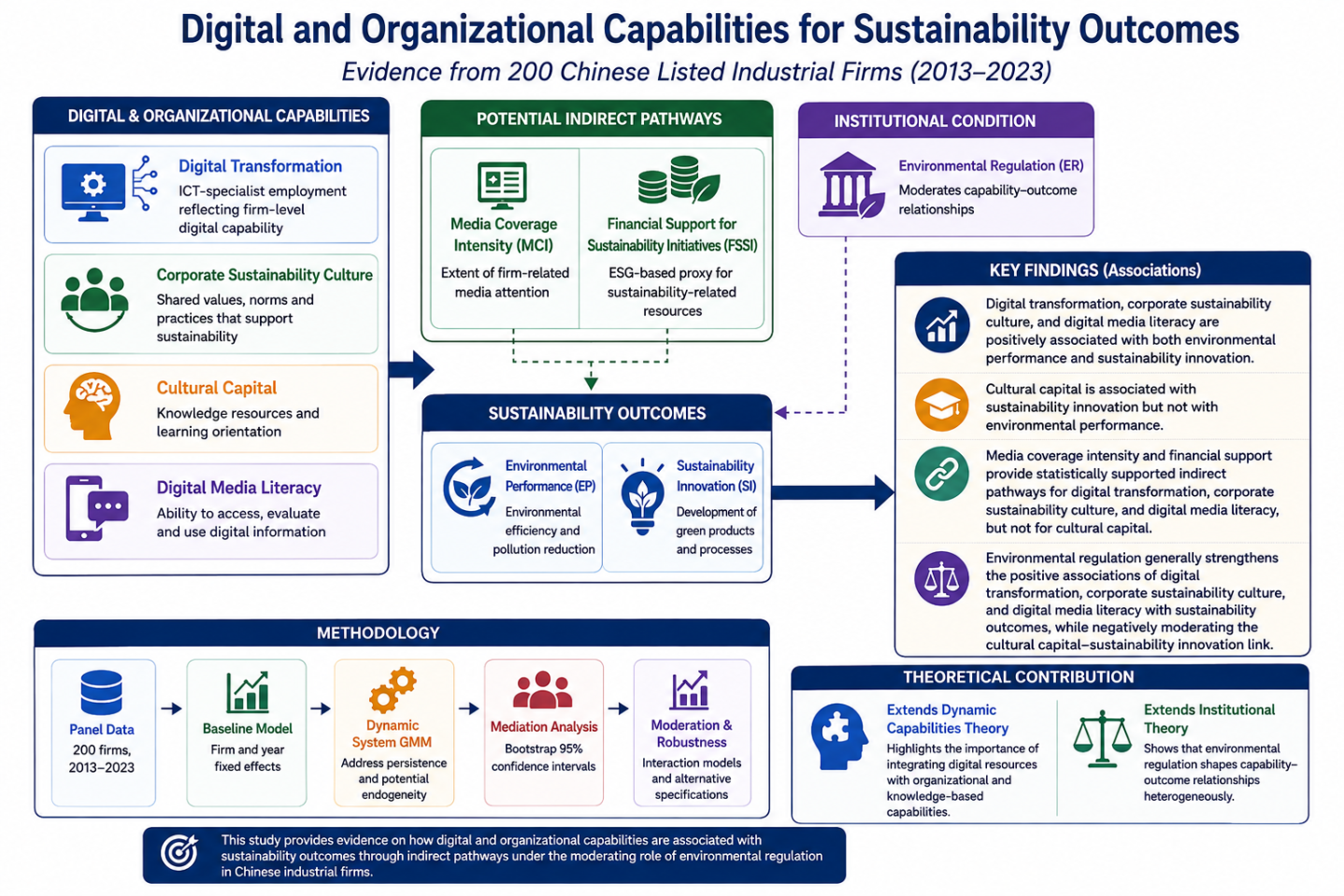
This study examined the associations between digital and organizational capabilities and sustainability outcomes among 200 industrial firms listed on the Shanghai Stock Exchange in China from 2013 to 2023. The study applied the theory of Dynamic Capabilities and Institutional Theory to explore the digital transformation, corporate sustainability culture, cultural capital and digital media literacy, and their relationship with environmental performance and sustainability innovation. Media coverage intensity and the financial support of sustainability initiatives were investigated as possible indirect pathways and environmental regulation as a moderating institutional condition. Firm and year fixed-effects models were supplemented with dynamic System GMM and bootstrapped indirect-effect analysis, moderation analysis, and robustness specifications. The findings indicate that digital transformation, corporate sustainability culture, and digital media literacy were positively associated with both environmental performance and sustainability innovation, whereas cultural capital was positively associated with sustainability innovation but not environmental performance. Media coverage intensity and financial support for sustainability initiatives showed statistically supported indirect associations for digital transformation, corporate sustainability culture, and digital media literacy, but not cultural capital. Environmental regulation generally strengthened the positive capability–sustainability associations, while its negative interaction with cultural capital for sustainability innovation provided only tentative evidence of a weakening association, as the interaction was significant only at the 10% level. These findings contribute to the Dynamic Capabilities Theory by bringing into focus capability-specific sustainability associations and the Institutional Theory by establishing differentiated regulatory conditions. The indirect effects and relationships estimated are therefore viewed as associative in nature for the purpose of the observational panel design.