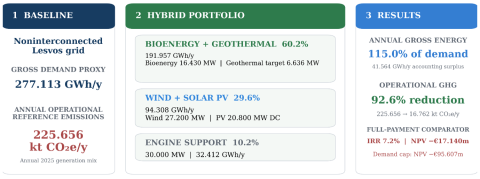
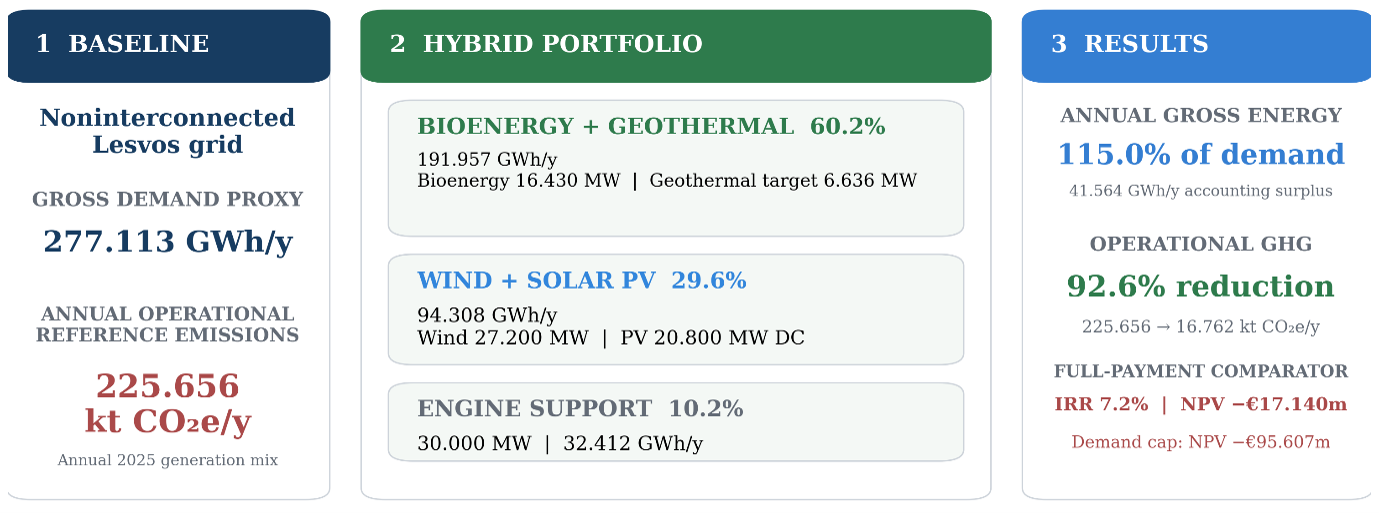
Non-interconnected islands require portfolios combining variable renewables with controllable low carbon generation. This study develops a Lesvos screening framework integrating bioenergy, a conditional geothermal target, wind, photovoltaics and limited dual fuel engine backup. RETScreen Expert and an Excel balance were applied to reconstructed 2025 electricity demand of 277.113 GWh. The 101.066 MW configuration produces 318.677 GWh annually. Renewables provide 286.265 GWh, or 89.8 percent. Bioenergy and geothermal generation contribute 191.957 GWh, equal to 60.2 percent, demonstrating the role assigned to dispatchable renewables. The seasonal screening allocation produces a 41.564 GWh annual accounting margin, but adverse and low-renewable peak tests identify supply deficits. With a EUR 77.372 million public contribution and full remuneration at EUR 0.16 per kWh, the project gives a 7.2 percent pretax internal rate of return, a 14.0 year simple payback and a negative EUR 17.140 million net present value at 9 percent. At an equal annual gross reference quantity, operational reference emissions decrease from 225.656 to 16.762 kt CO₂e, a 92.6 percent reduction. The demand-capped payment gives NPV of EUR -95.607 million. The study provides a transparent island transition portfolio while identifying resource, dispatch, surplus, financial and emissions assumptions requiring validation before investment.