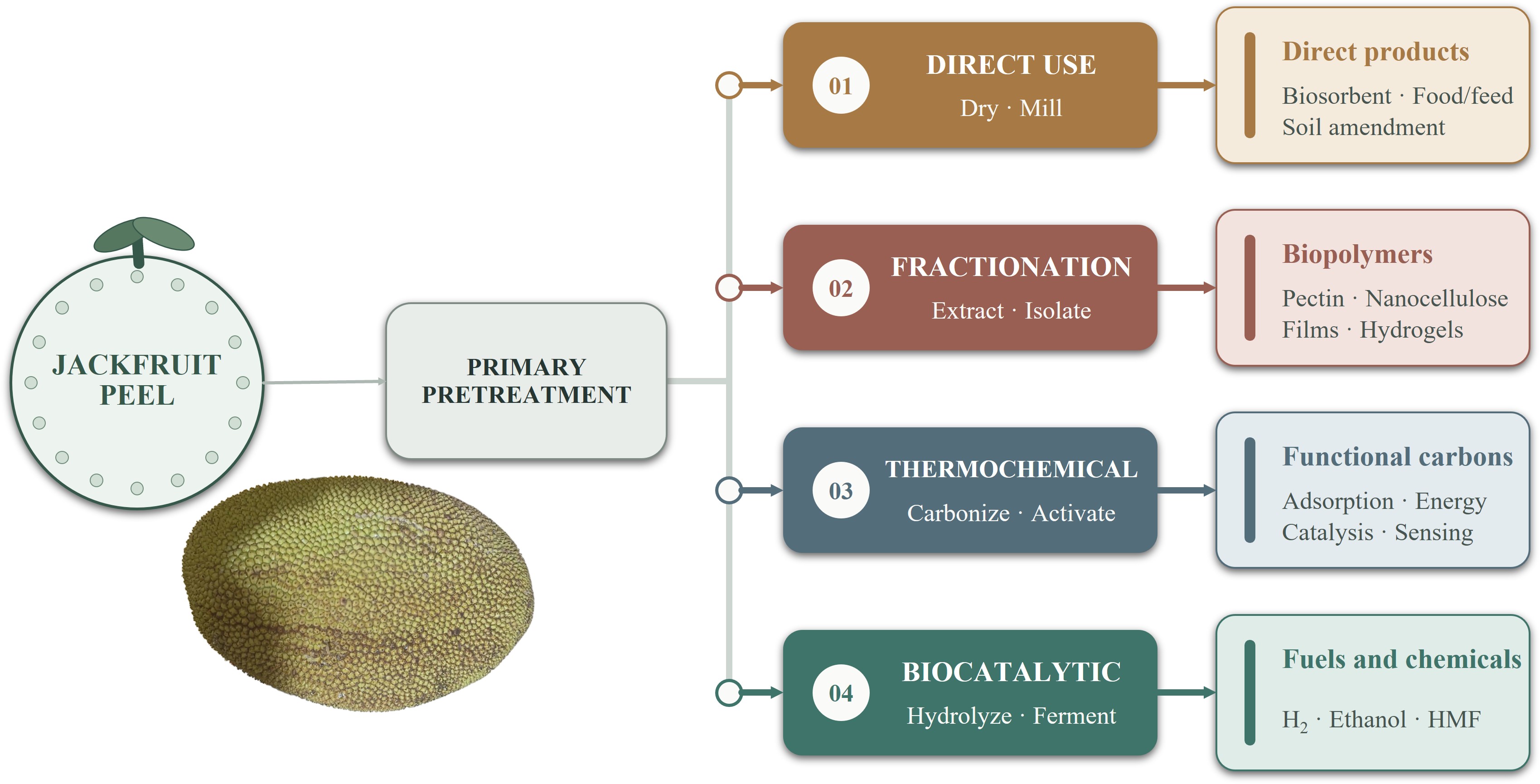
Jackfruit peel is a renewable feedstock for environmental remediation and resource recovery, but research remains fragmented across applications. This review combines bibliometric mapping with critical evaluation of valorization pathways. Following a Web of Science Core Collection search on 18 September 2026, 167 publications spanning 2002–2026 were retained. R was used for descriptive and temporal analyses, and VOSviewer for keyword co-occurrence mapping. Publications from 2020–2025 accounted for 67.1% of the corpus. Three thematic clusters covered adsorption and remediation, recovery of biopolymers and bioactive compounds, and functional carbon materials. Across applications, feedstock composition, pretreatment and material structure influenced reported performance. Practical implementation remains constrained by inconsistent characterization, limited regeneration and continuous-flow validation, and insufficient safety, techno-economic and life-cycle evidence. The review connects these research patterns and limitations through a cascade framework involving phenolic and pectin recovery, cellulose utilization, and conversion of residual solids into carbon materials or energy products. Its proposed advantages require verification through mass balances, pilot-scale testing and integrated economic and environmental assessment.