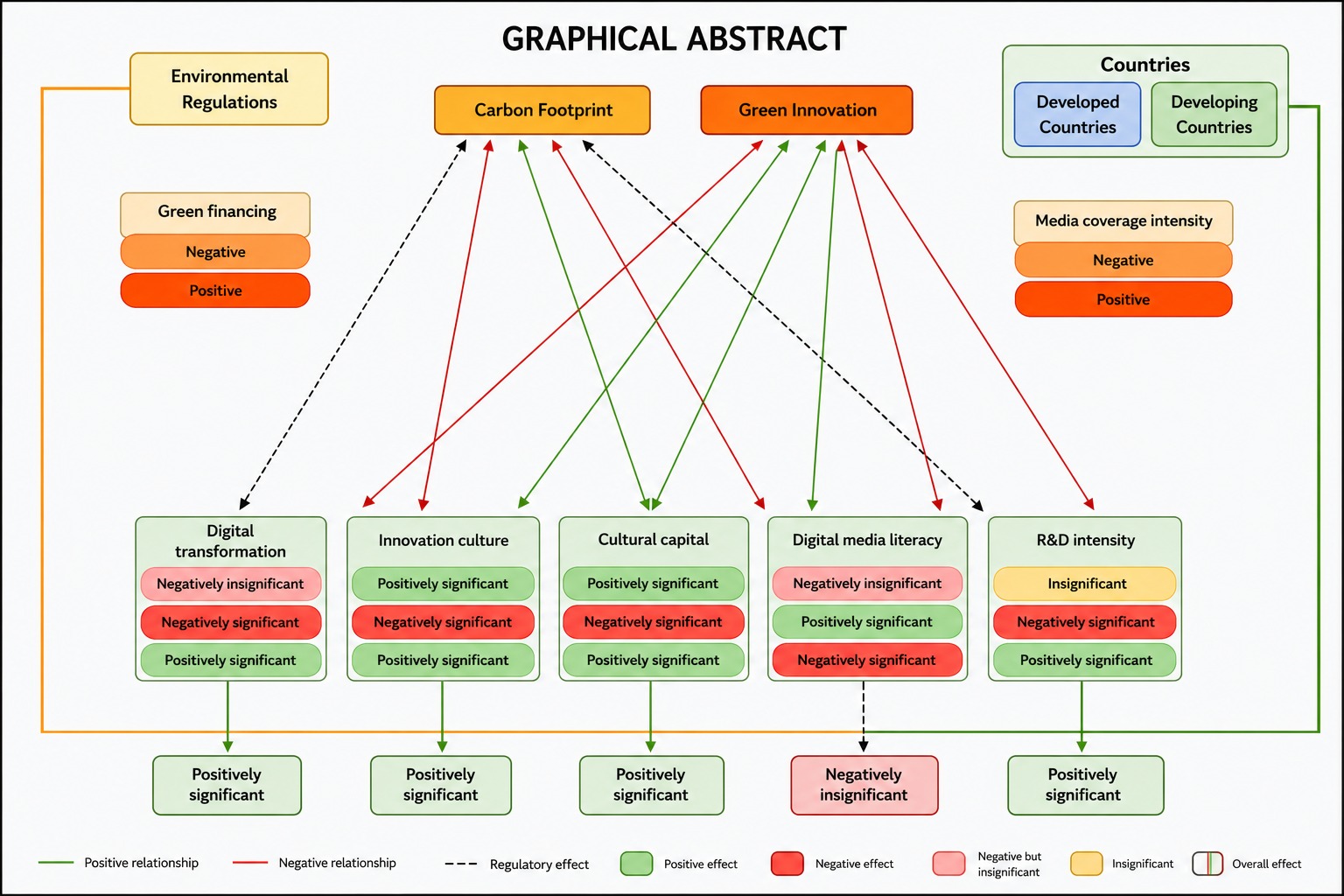
This study examines how digital transformation, innovation culture, cultural capital, digital media literacy, and research and development (R&D) intensity influence carbon footprint reduction and green innovation in developed and developing economies. It also explores the mediating mechanism of media coverage intensity and green finance, and the moderating mechanism of environmental regulations. The study uses secondary panel data from 10 developed and 10 developing countries covering the period 2000–2024. Data were obtained from the World Development Indicators (WDI), OECD, and Eurostat databases and analysed using the two-step System-Generalised Method of Moments (System-GMM) estimator. The results show significant differences in developed and developing economies. Digital transformation and innovation culture have stronger positive effects on carbon footprint reduction and green innovation in developed economies than in developing economies because of differences in digital infrastructure, institutional quality, financial development, and dependence on fossil fuels. Likewise, in developed economies, cultural capital and R&D intensity have a more positive influence on carbon footprint reduction and green innovation than in the developing economies in which institutional and resource weaknesses limit the impact of these factors. Media coverage intensity and green finance serve as the important mediating variables and environmental regulations amplify the relationship between the explanatory variables and carbon footprint reduction and green innovation under different degrees of effects, with the former role being stronger in developed countries. Theoretically, the study combines the concepts of Institutional Theory with Resource Based View (RBV) to understand that knowledge of the role of strategic resource capability and institutional environment taken together on environmental performance in different economic conditions. From a methodological perspective, it presents comparative evidence based on a dynamic panel approach, and its results conclude with policy recommendations to signal the need for improving digital infrastructure, green finance, and institutional quality to drive the faster and more sustainable transitions, especially in developing economies.