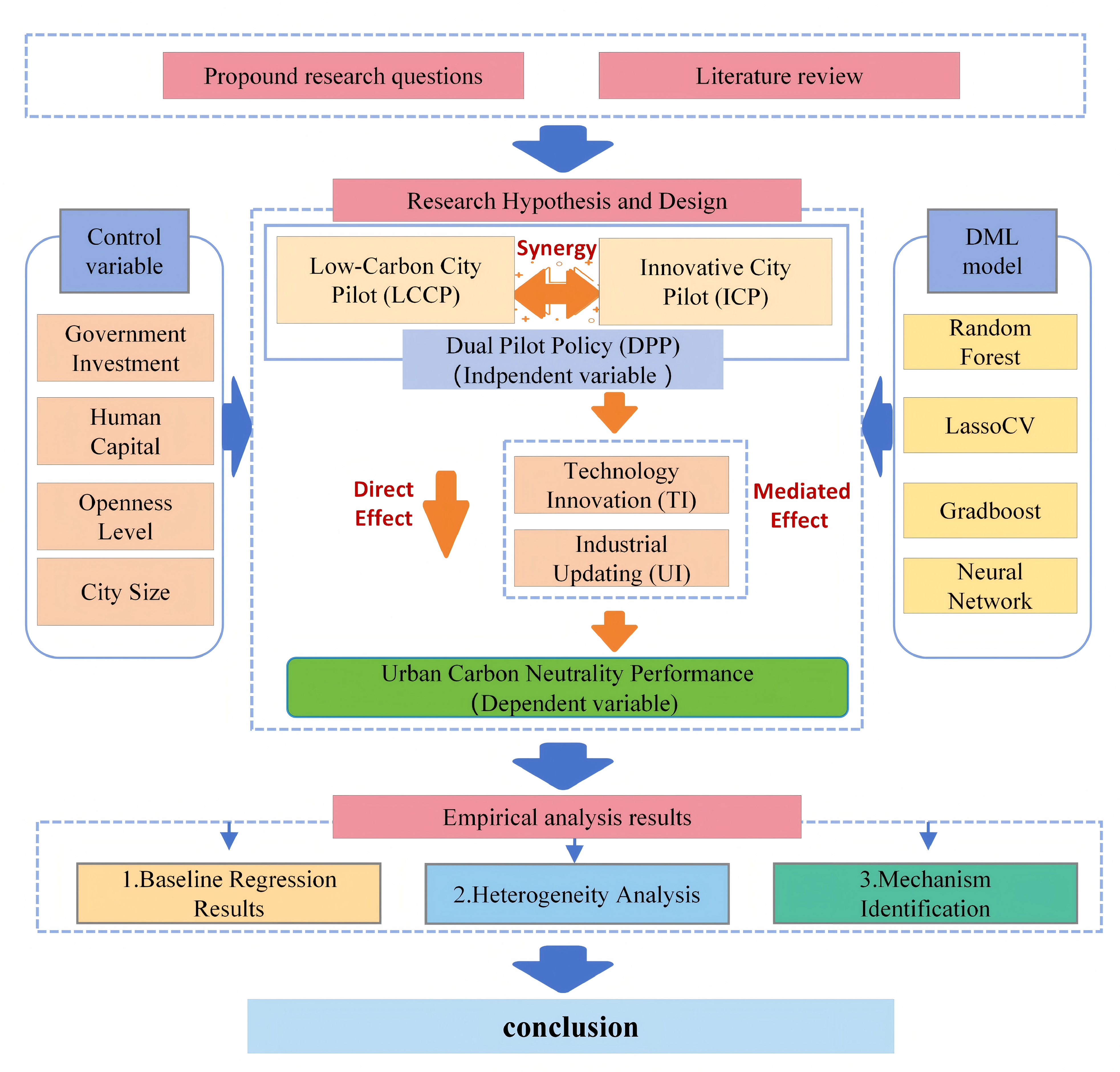
Achieving carbon neutrality requires not only setting ambitious goals but also effectively integrating existing policy instruments. Although multiple pilot programs have been launched to promote green transformation, empirical evidence on whether these initiatives can synergistically advance regional low-carbon transition processes remains fragmented. This study reassesses the impacts of two landmark policies in China—the Low-carbon City Pilot (LCCP) and the Innovative City Pilot (ICP). We introduce an urban carbon neutrality performance (UCNP) index covering development foundation, low-carbon status, and emission reduction trends, thereby providing a comprehensive evaluation framework for the research. Based on data from 266 Chinese cities over the period 2010–2020, this paper employs a Double Machine Learning (DML) approach to examine the individual effects, synergistic effects, and underlying mechanisms of these two policies. Baseline regression results indicate that both the LCCP and ICP significantly enhance UCNP, and the two policies exhibit a notable synergistic effect. Moreover, compared with cities participating in only a single pilot, cities designated as dual pilot cities demonstrate stronger policy effects in improving UCNP. Heterogeneity analysis reveals that the impact of the dual pilot policy (DPP) on urban carbon neutrality performance is more pronounced in non-resource-based cities and coastal cities. This study also finds that policy effects vary across different pilot batches. Mechanism analysis shows that dual pilot cities influence the carbon neutrality process through two mediating channels: technological innovation and industrial upgrading. The findings indicate that the two pilot policies exert significant positive effects on advancing urban carbon neutrality processes. To further promote regional green and low-carbon development, policymakers and implementers urgently need to strengthen the coordination of policy objectives, policy contents, and policy instruments among different pilot policies.