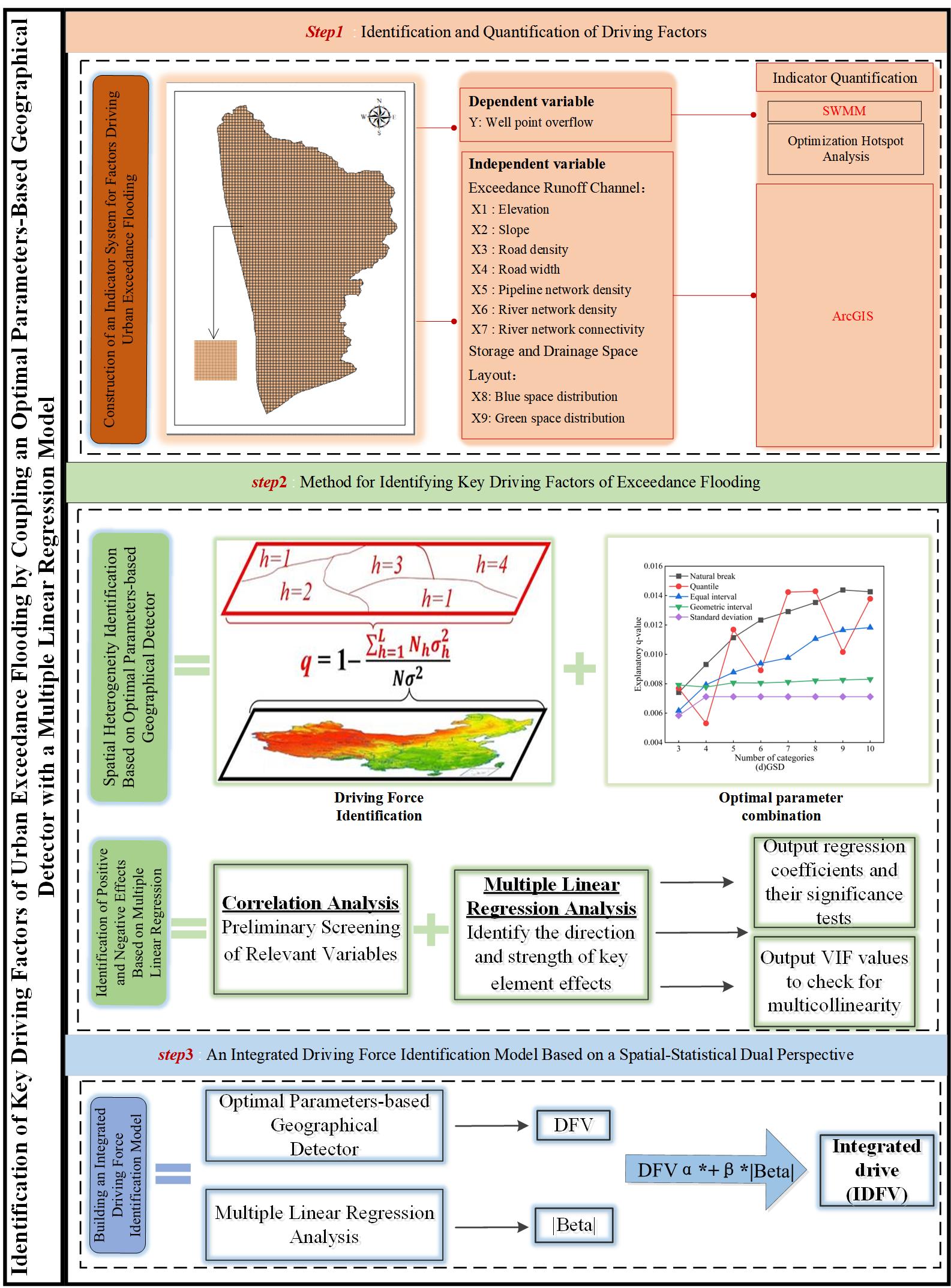
Amplified by global climate change, the frequency and intensity of extreme precipitation events are escalating, leading to increasingly severe urban exceedance flooding. Identifying the key drivers of urban exceedance flooding carries profound theoretical significance and practical implications. Existing approaches face significant challenges in terms of comprehensiveness and precision for key drivers identification of urban exceedance flooding. The study proposes an integrated approach for identifying key driving factors of urban exceedance flooding based on spatio-statistical dual perspective, coupling the Optimal Parameters-based Geographical Detector (OPGD) with multiple linear regression (MLR). Firstly, an urban exceedance flooding potential driving factors system is constructed, categorized into two dimensions like exceedance runoff channel and storage-drainage space layout and totally nine indicators. Subsequently, the OPGD and MLR models are employed to quantify the influence of each driver on flooding intensity from the explanatory power for spatial heterogeneity and the direction-magnitude of statistical effects. Furthermore, by applying a weighted fusion of spatial and statistical association measures, the Integrated Driving Force Value (IDFV) index is proposed for each driver, representing its influence on flooding intensity. This methodology effectively integrates the respective strengths of the two models, enhancing the scientific rigor and reliability of the identification results and overcoming the limitations of the traditional Geographical Detector, which cannot indicate the direction of influence. It is applied to the Chongqing High-tech Industrial Development Zone, China, demonstrating enhanced accuracy and robustness in identifying the key drivers of exceedance flooding. In summary, this study provides a novel methodology for identifying the critical drivers of urban exceedance flooding, offering practical guidance for urban disaster prevention, mitigation, and spatial planning.