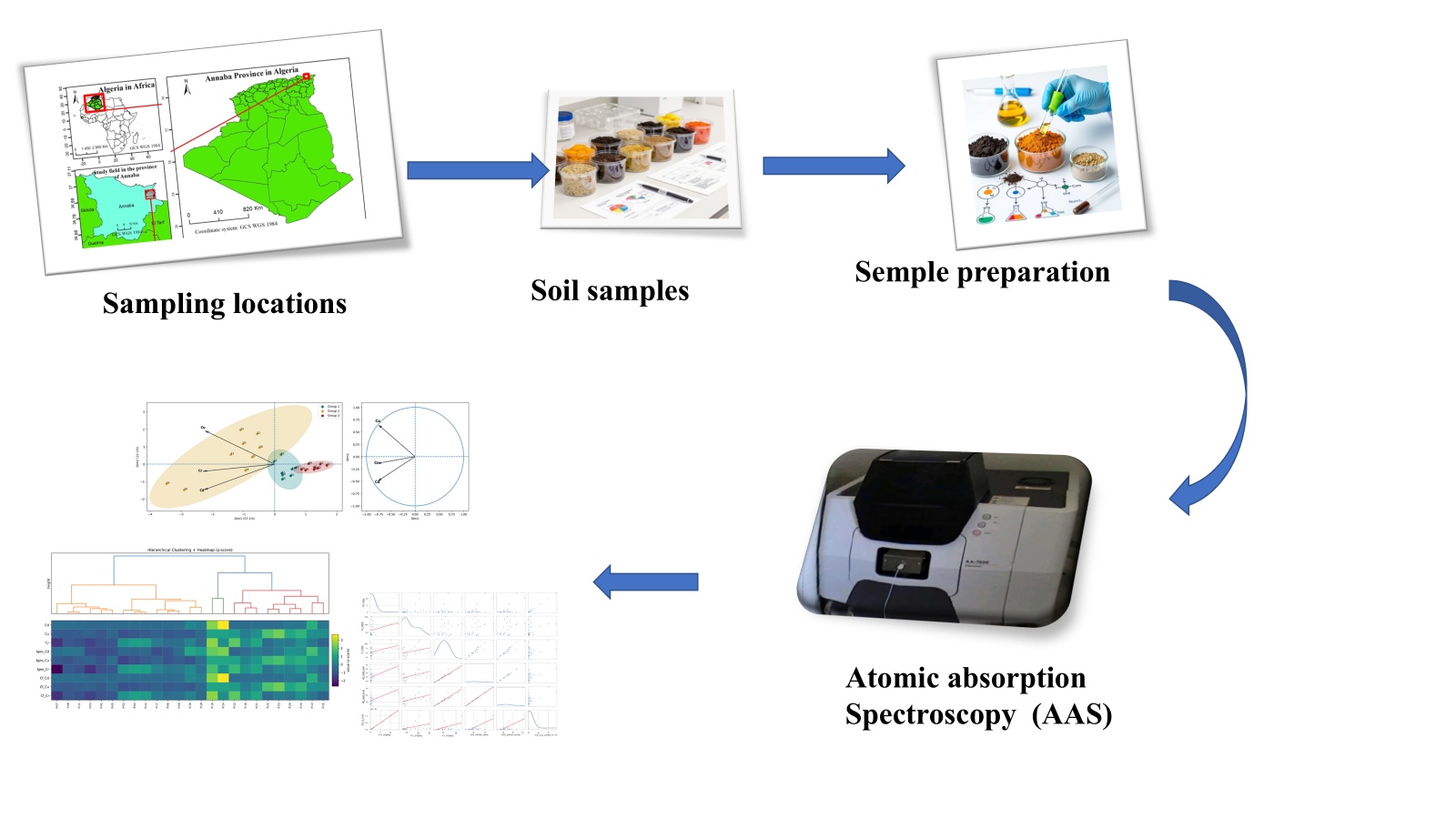
Urban soils represent significant sinks for heavy metals and may constitute potential risks to human health, particularly within rapidly urbanizing and industrialized settings. This study assesses the concentrations, spatial distribution, and associated human health risks of cadmium (Cd), copper (Cu), and chromium (Cr) in surface soils of Annaba City, northeastern Algeria.
A total of 25 surface soil samples were collected following a land-use-based sampling design encompassing industrial areas, high-traffic corridors, residential neighborhoods, and urban green spaces, in order to capture spatial heterogeneity and potential contamination sources. The measured concentrations ranged from 0.12 to 14.01 mg·kg⁻¹ for Cd, 30.56 to 152.17 mg·kg⁻¹ for Cu, and 15.24 to 121.24 mg·kg⁻¹ for Cr. Among the analyzed metals, cadmium exhibited the greatest spatial variability and the highest degree of enrichment relative to local background levels.
Pollution assessment using the contamination factor (CF) and geo-accumulation index (Igeo) revealed moderate to extreme Cd contamination at several industrial locations. Copper generally fell within moderate contamination categories, whereas chromium concentrations remained predominantly within low to moderate contamination classes when compared with regulatory reference values. Geographic information system (GIS)-based spatial analysis identified distinct contamination hotspots, particularly at sites P-14, P-19, and P-24, which spatially correspond to areas influenced by industrial activities.
Human health risk assessment (HHRA) indicated that non-carcinogenic hazard index (HI) values were systematically higher for children than for adults. Nevertheless, all estimated HI values remained below the acceptable risk threshold (HI < 1). Cadmium contributed most substantially to the total non-carcinogenic risk at hotspot locations. The estimated carcinogenic risk associated with Cd inhalation was negligible across all sampling sites, remaining several orders of magnitude below the commonly accepted benchmark level (10⁻⁶).
Multivariate statistical analyses, including principal component analysis and hierarchical cluster analysis, corroborated the observed spatial patterns and emphasized the dominant role of cadmium in controlling contamination variability and differentiating industrially impacted soils from less affected areas. Overall, the integrated application of pollution indices, GIS-based spatial mapping, HHRA, and multivariate techniques identifies cadmium as the principal environmental concern in Annaba’s urban soils and provides a robust scientific basis for targeted monitoring strategies and risk-oriented urban soil management.