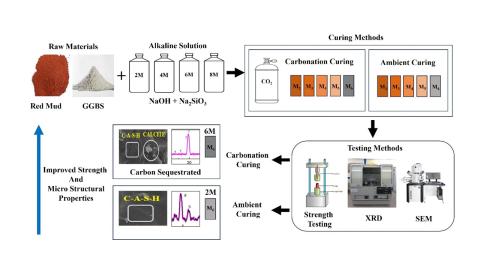
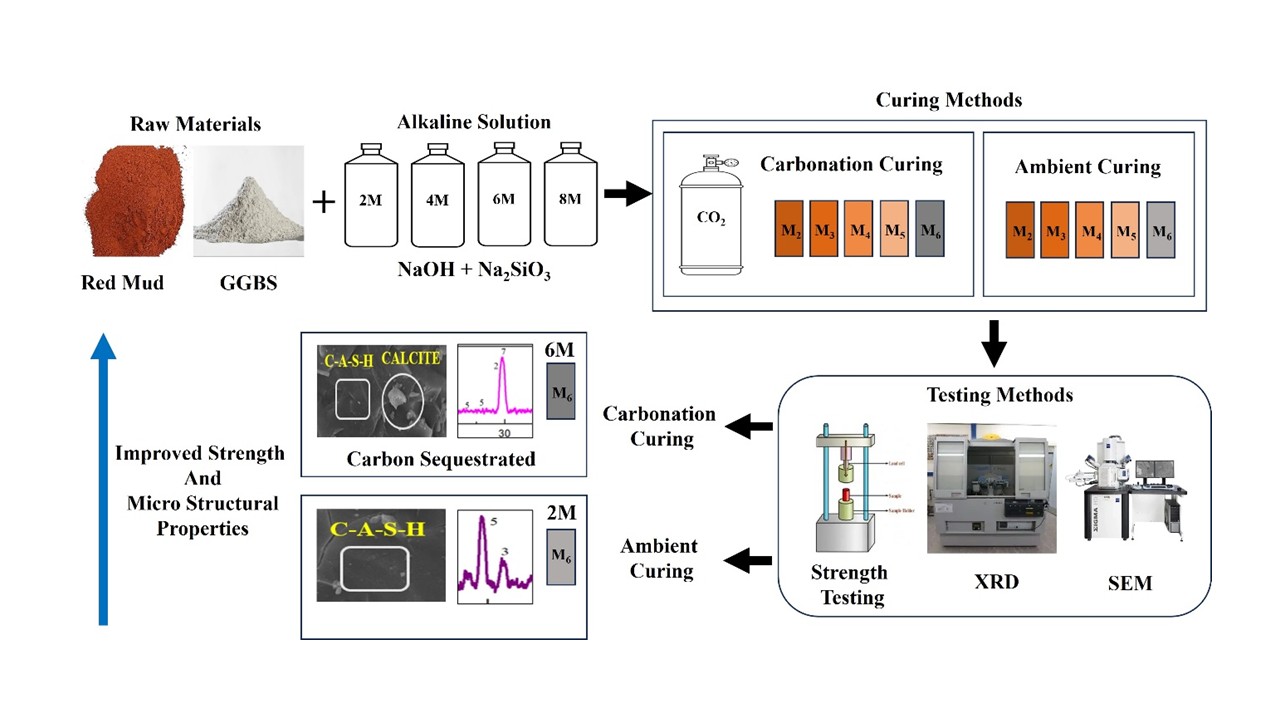
Currently the focus on the mitigation of CO2 emissions is receiving great appreciation worldwide through the use of different technologies. Mineral carbonation technology was employed for CO2 fixation using industrial byproducts such as Red Mud (RM) and Ground Granulated Blast Furnace Slag (GGBS) as precursor materials. The sustainable utilization of these industrial byproducts in geopolymers used two different curing regimes such as carbonation curing and ambient curing to evaluate the effect of CO2 exposure on binder performance. The strength and micro structural properties were observed by testing compressive strength, X-ray diffraction (XRD) and Scanning Electron Microscopy (SEM) analyses. The carbon sequestration potential of the binder material was determined using CO2 uptake values derived from thermogravimetric analysis (TGA). These analyses confirmed carbon fixation within the binder material during curing. This study ensures the solidification of geopolymers without any CO2 emissions and uptake of carbon to improve mechanical strength. Ambient-cured samples were used to determine the reliable strength gain and better micro-structural development of carbonated samples. The results indicated the advantages of integrating mineral carbonation for CO2 sequestration with carbonation curing, leading to an overall reduction in the carbon footprint and enhanced mechanical properties of the RM-GGBS based geopolymer paste relative to traditional ambient curing. Regardless of the molarities used in this study (2M, 4M, 6M and 8M) and curing conditions, GGBS-based samples performed well. In particular, the carbonation cured GGBS sample proved better mechanical strength, structural integrity and mitigation of carbonation induced degradation. The better CO2 uptake observed in RM-rich mixes is attributed to their enhanced alkalinity, whereas GGBS-rich systems exhibit comparatively moderate carbonation capacity.