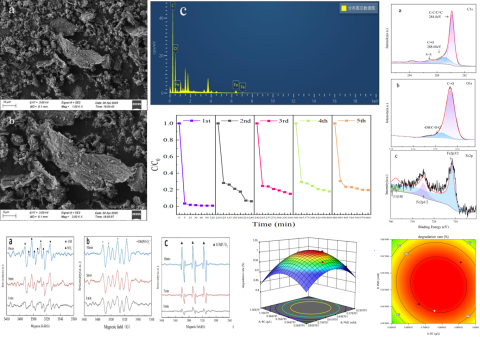
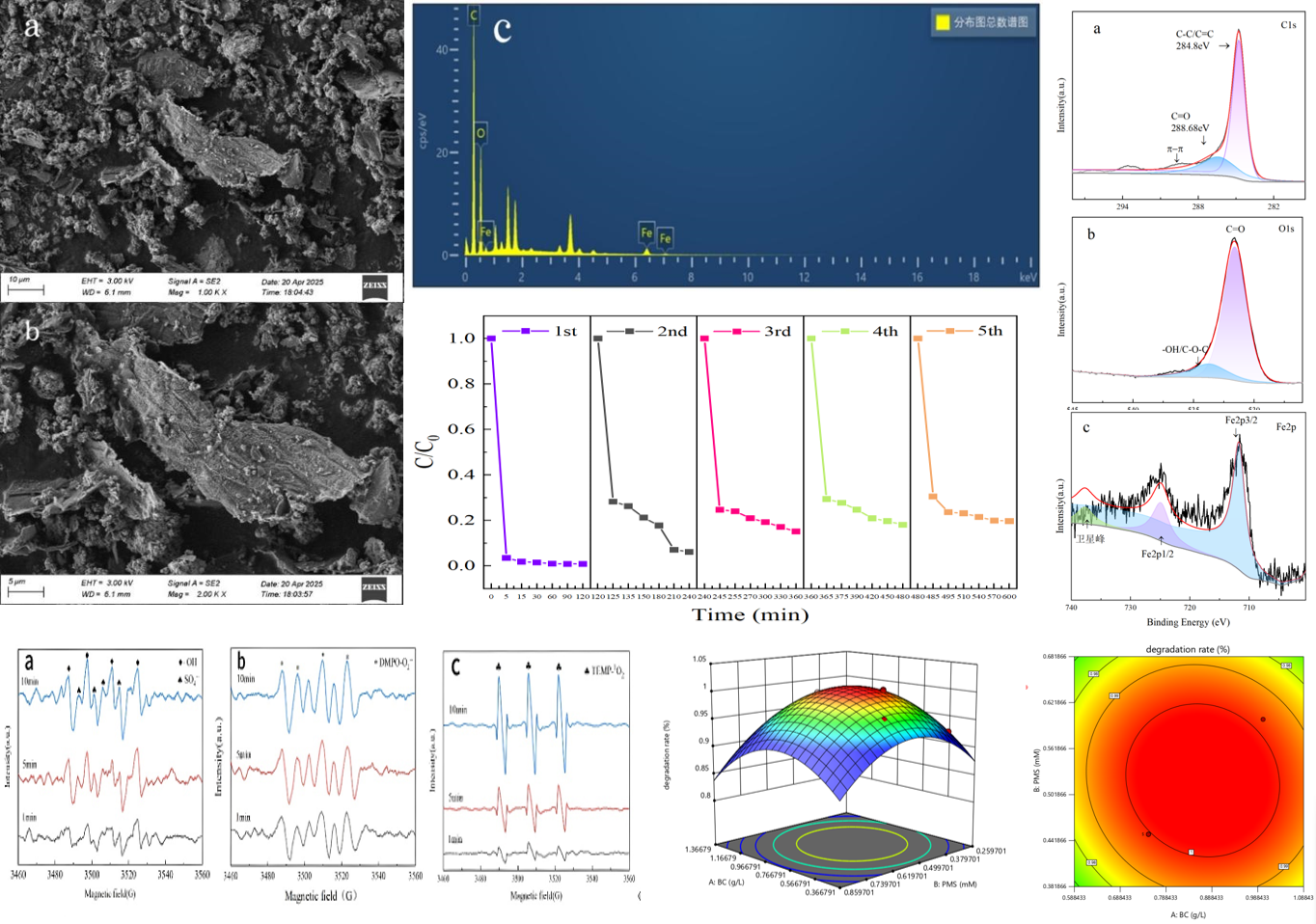
To address tetracycline (TC) contamination in water, red mud biochar (RM‑BC) was synthesized from red mud and peanut shells via a one-step pyrolysis method and subsequently used to activate peroxymonosulfate (PMS) for TC degradation. The RM‑BC/PMS system achieved over 99% TC removal within 120 min. Characterization by SEM, XRD and XPS revealed that Fe3O4 nanoparticles were uniformly dispersed on the biochar surface, providing abundant active sites. Radical quenching tests and EPR analysis demonstrated that TC degradation proceeded through both radical pathways (SO₄•⁻ and •OH) and a non‑radical pathway (¹O₂). Response surface methodology was employed to optimize the degradation conditions, identifying an RM‑BC dosage of 0.81 g/L, PMS concentration of 0.57 mM and pH 7.13 as optimal, under which the experimental removal efficiency reached 99.5%. In addition, the RM‑BC catalyst retained over 82% removal efficiency after five consecutive reuse cycles with minimal heavy metal leaching, confirming its high stability and reusability. This work presents a sustainable strategy for valorizing industrial solid waste and efficiently treating antibiotic‑containing wastewater.