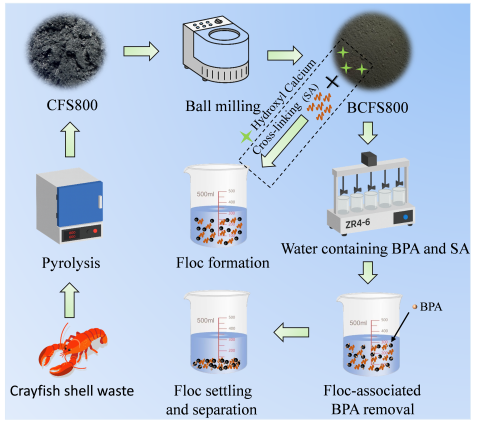
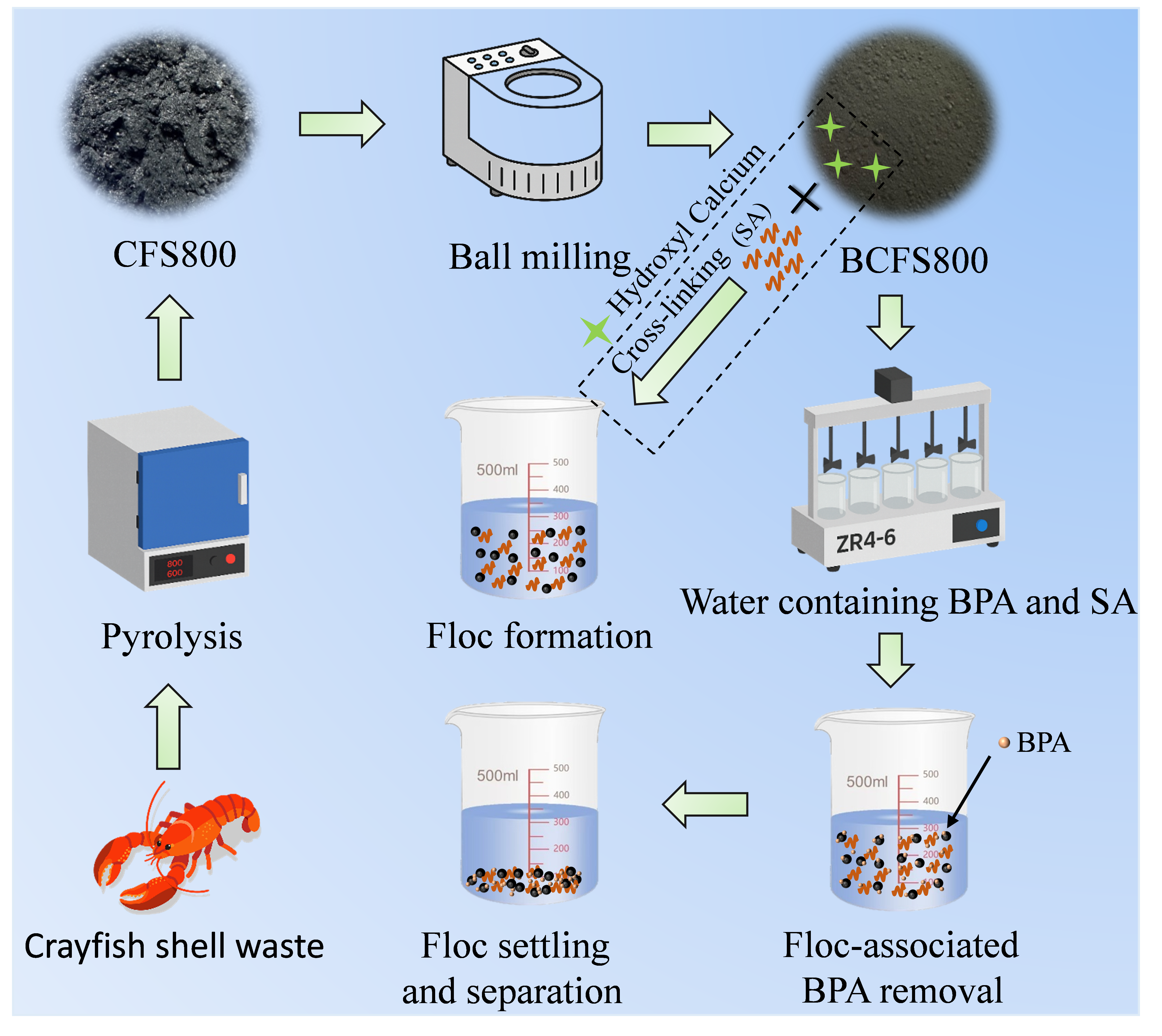
Bisphenol A (BPA), a representative endocrine-disrupting chemical, is widely present in aquatic environments and poses potential risks to ecosystems and human health. In conventional water treatment, the presence of natural organic matter (NOM), particularly polysaccharides, often interferes with pollutant removal and reduces treatment efficiency. In this study, a Ca-rich biochar (BCFS800) was prepared from restaurant-derived crayfish shell waste to investigate the mechanism of synergistic BPA removal with a natural polysaccharide, sodium alginate (SA). The results show that hydroxyl-calcium species enriched on the BCFS800 surface can crosslink with SA to form stable gel-like flocs, thereby enhancing BPA removal. Under the conditions of BCFS800 2.5 g/L, SA 50 mg/L, initial pH 6, rapid mixing at 250 r/min for 10 min, and slow mixing at 60 r/min for 10 min, BPA removal reached approximately 76%, and effluent turbidity decreased markedly, indicating favorable treatment performance and settling behavior. Characterizations by BET, SEM, XRD, FTIR, and XPS demonstrate that ball milling increased the specific surface area and promoted the exposure of Ca-based reactive sites, strengthening the crosslinking capability between BCFS800 and SA and improving floc formation. Mechanistic analysis suggests that BPA removal by the gel-like flocs is mainly driven by sweep flocculation coupled with surface adsorption, accompanied by π–π interactions and hydrogen bonding. Overall, this work demonstrates that Ca-rich crayfish shell biochar can convert natural polysaccharides from adsorption interferents into building units for gel-floc construction, providing new insights and support for green water treatment under NOM-impacted conditions.