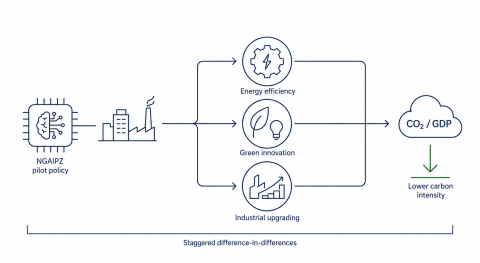
This paper examines how artificial intelligence affects urban carbon-emission intensity from a production-side perspective. We exploit the staggered rollout of China’s National New Generation Artificial Intelligence Innovation and Development Pilot Zone (NGAIPZ) program and use a balanced panel of 288 prefecture-level cities from 2014 to 2023. Difference-in-differences estimates show that the NGAIPZ program significantly reduces urban carbon-emission intensity. Further results provide evidence consistent with potential production-side channels involving improved energy efficiency, greater green innovation, and industrial upgrading. The carbon-intensity effect is stronger in cities with weaker environmental regulation, indicating that intelligent production and management systems create larger reductions in carbon intensity where conventional regulatory pressure is limited. The effect is also more pronounced in cities with better internet infrastructure, which supports data circulation and the diffusion of AI applications. These findings indicate that AI-oriented policy can improve urban carbon efficiency alongside changes in energy use, green innovation, and the organization of production.