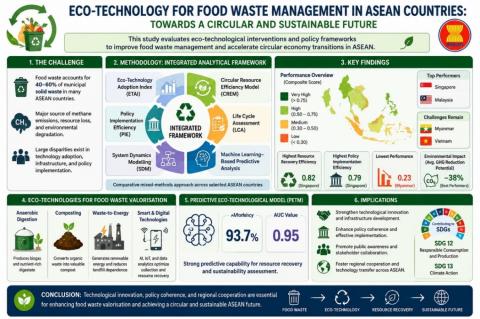
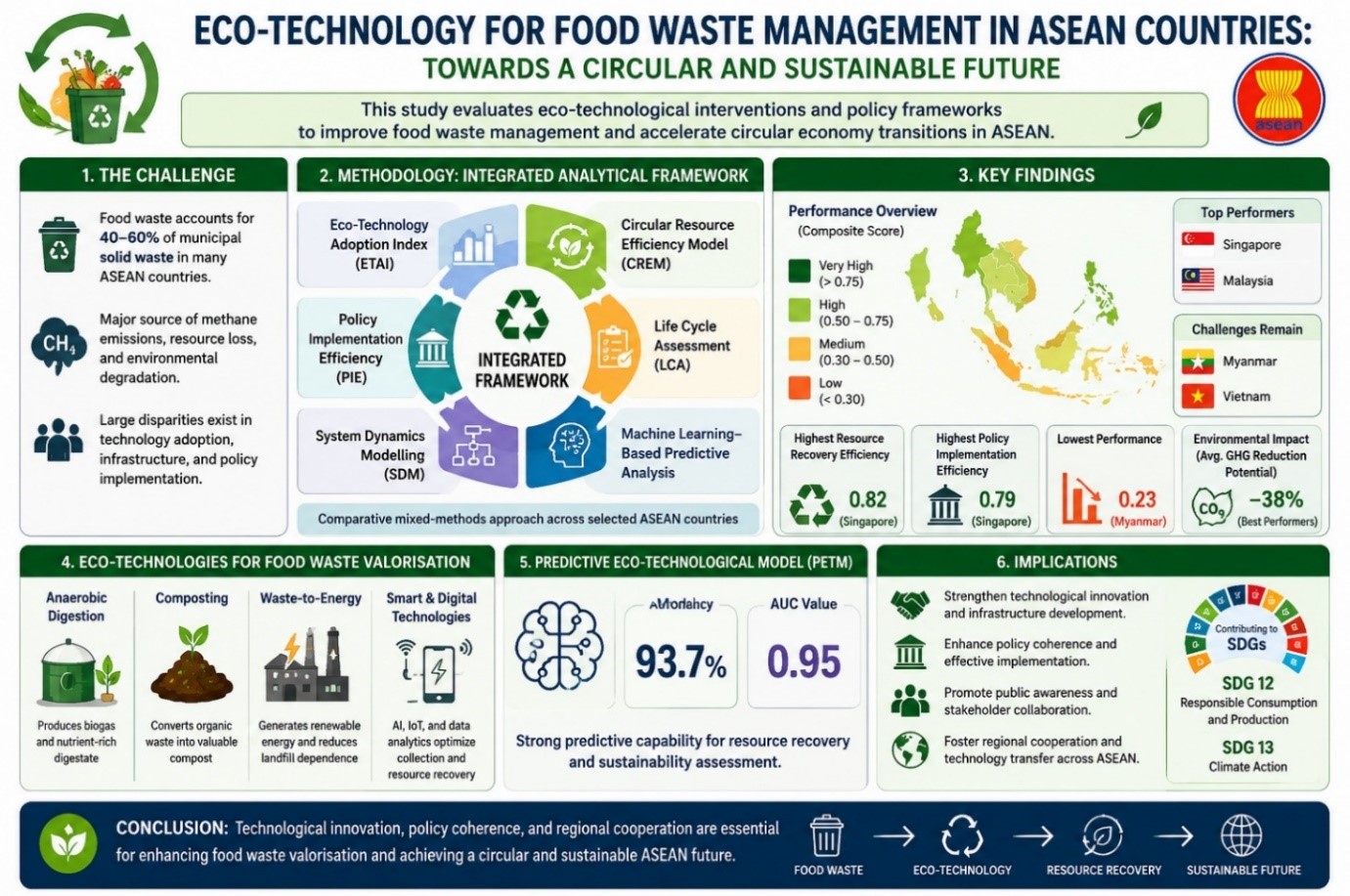
Food waste management has emerged as a critical sustainability challenge in ASEAN countries due to rapid urbanisation, population growth, and changing consumption patterns. This study investigates the role of eco-technological interventions and policy frameworks in improving food waste management and accelerating circular economy transitions across the region. A comparative mixed-methods approach was employed, integrating the Eco-Technology Adoption Index (ETAI), Circular Resource Efficiency Model (CREM), Policy Implementation Efficiency (PIE), Life Cycle Assessment (LCA), and machine learning-based predictive analysis to evaluate food waste management performance in selected ASEAN countries. The findings reveal significant disparities in technological readiness and governance effectiveness, with Singapore and Malaysia demonstrating the highest levels of eco-technology adoption, resource recovery efficiency, and environmental performance. At the same time, Myanmar and Vietnam face substantial infrastructural and institutional challenges. The proposed Eco-Technological Model achieved an accuracy of 93.7% and an AUC value of 0.95, indicating strong predictive capability for resource recovery and sustainability assessment. The study concludes that technological innovation, policy coherence, and regional cooperation are essential for enhancing food waste valorisation and achieving Sustainable Development Goals, particularly SDG 12 and SDG 13, within the ASEAN region.