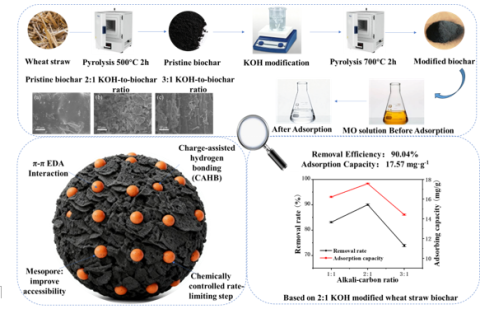
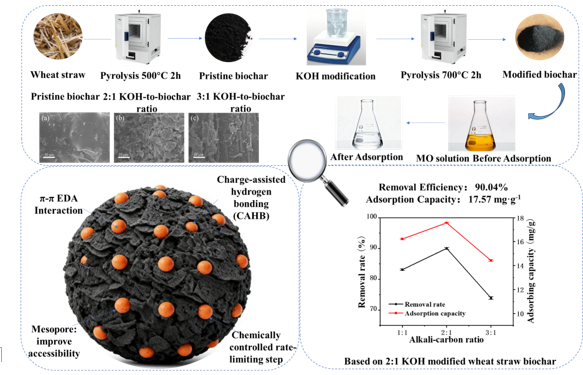
Methyl orange (MO), an anionic azo dye commonly found in textile wastewater, is resistant to conventional treatment due to its refractory nature. Adsorption offers a cost-effective alternative, and wheat straw, an abundant agricultural residue, was used to prepare activated biochar. When tested with 40 mg/L MO at pH 7 and 25 °C using an adsorbent dosage of 0.10 g, the biochar achieved a maximum adsorption capacity of 17.57 mg/g and a removal efficiency of 90.04%. The adsorption followed the Langmuir isotherm (R² > 0.998), with maximum capacities ranging from 26.62 to 22.25 mg/g at 25–45 °C, and obeyed pseudo-second-order kinetics (R² > 0.999), indicating that the adsorption rate is governed by chemically driven interactions. Notably, the mesoporous structure (Type IV isotherm) and Langmuir monolayer adsorption behavior were reconciled, revealing that mesopores serve primarily as mass-transfer conduits rather than multilayer accommodation sites. This work demonstrates that KOH-activated wheat straw biochar is a cost-effective and sustainable adsorbent for anionic dye wastewater treatment, offering a viable strategy for agricultural waste valorization.