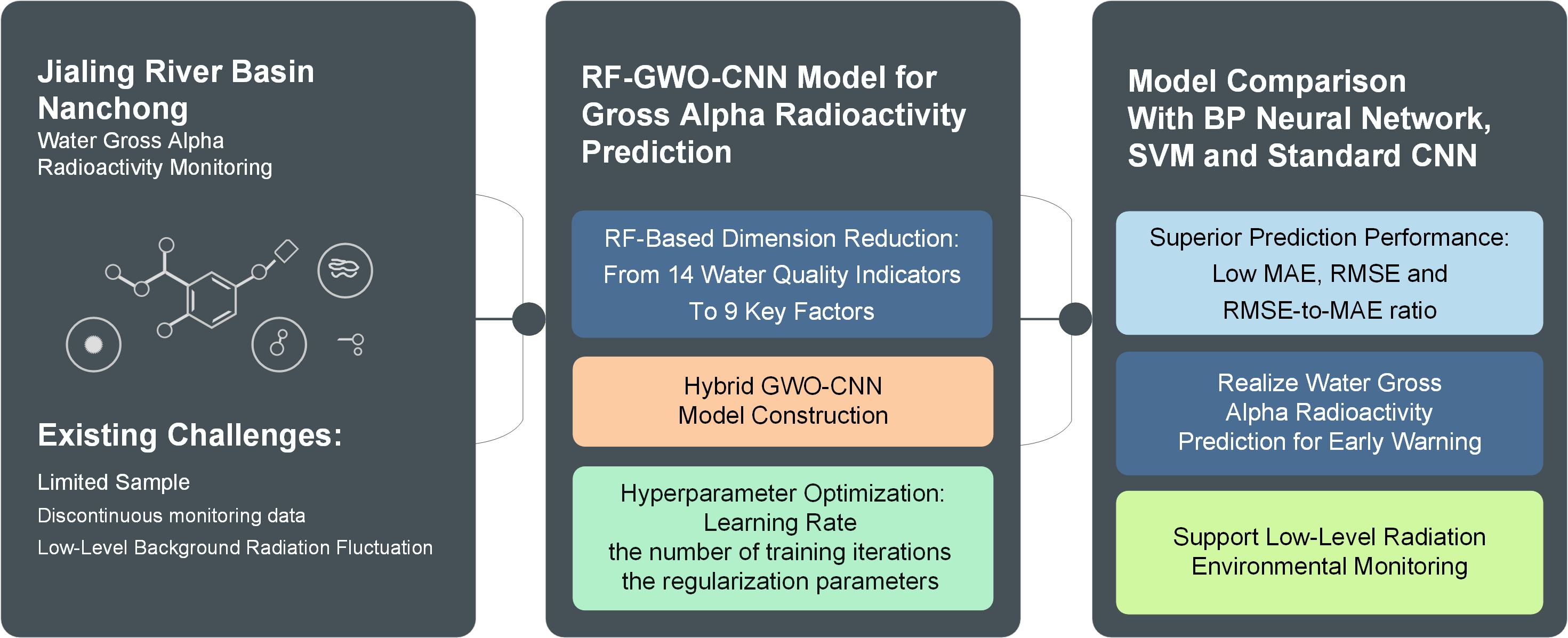
Monitoring gross alpha radioactivity in water is essential for assessing the health risks associated with nuclear energy utilization. In the Jialing River basin (Nanchong), prediction is hindered by scarce samples, discontinuous monitoring, and the statistical fluctuations of low-background radiation. This paper proposes an integrated RF-GWO-CNN framework that couples Random Forest (RF) feature selection with a Convolutional Neural Network (CNN) tuned by Gray Wolf Optimization (GWO). The RF Gini importance ranking narrows fourteen candidate inputs (eight routine water-quality parameters plus geographic, meteorological and temporal variables) to nine key predictors, and GWO automatically optimizes the learning rate, training epochs and regularization of the CNN. Using 100 samples from 15 monitoring sites, the framework is compared with backpropagation (BP), support vector machine (SVM), a standard CNN, and two tree-ensemble regressors under repeated five-fold cross-validation. It reaches a cross-validated RMSE of 0.017 Bq/L and MAE of 0.013 Bq/L, on par with the random-forest and CNN baselines and significantly better than SVM (Wilcoxon signed-rank test, p < 0.05). The strength of the approach is an interpretable, automatically tuned pipeline that turns routine, rapidly measured indicators into early warning of gross alpha radioactivity where monitoring data are sparse.