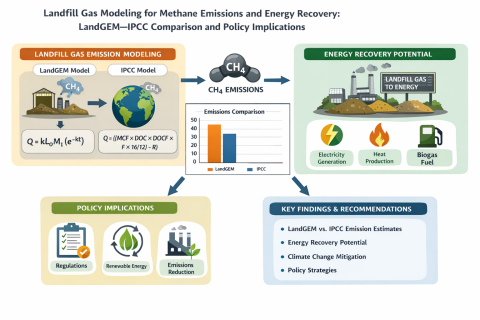
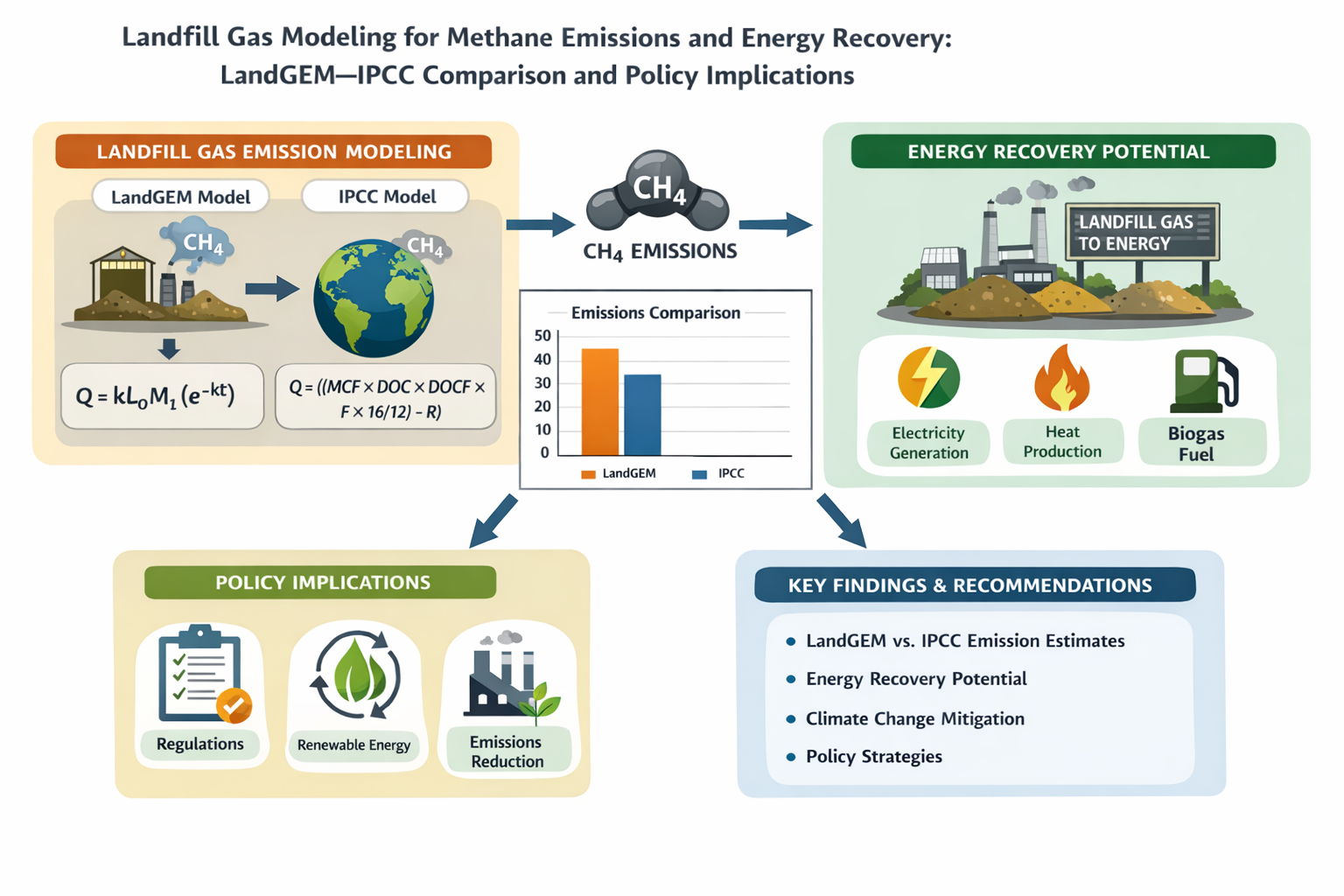
Landfill methane (CH₄) emissions represent a significant greenhouse gas (GHG) source globally. This study presents the first simultaneous application and comparison of the LandGEM v3.02 and IPCC Tier 1 models for the Erbil City landfill, Kurdistan Region, Iraq, covering waste acceptance from 2001 to 2031. LandGEM parameters (k = 0.05 year⁻¹; L₀ = 170 m³/Mg) and IPCC parameters (DOC = 0.18; DOCf = 0.70; MCF = 0.8; F = 0.5) were applied, with energy recovery estimated at 75% CH₄ collection efficiency and 33% electrical conversion efficiency. Peak CH₄ emissions in 2032 are projected at 8.9 × 10⁷ m³/year (LandGEM) and 1.8 × 10⁸ m³/year (IPCC), yielding energy potentials of 206 and 416 GWh/year, respectively. The divergence arises because IPCC Tier 1 omits first-order decay kinetics, producing an upper-bound estimate, directly affecting landfill gas collection system sizing and infrastructure decisions. Gross revenue potential ranges from $24–58 million/year, or $10–16 million/year under conservative 40% collection efficiency. All results are model-based projections without field validation. Findings support prioritizing active gas collection infrastructure to convert Erbil’s landfill into a renewable energy asset and provide a quantitative basis for regional waste management policy.