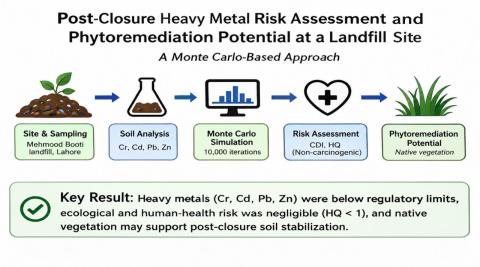
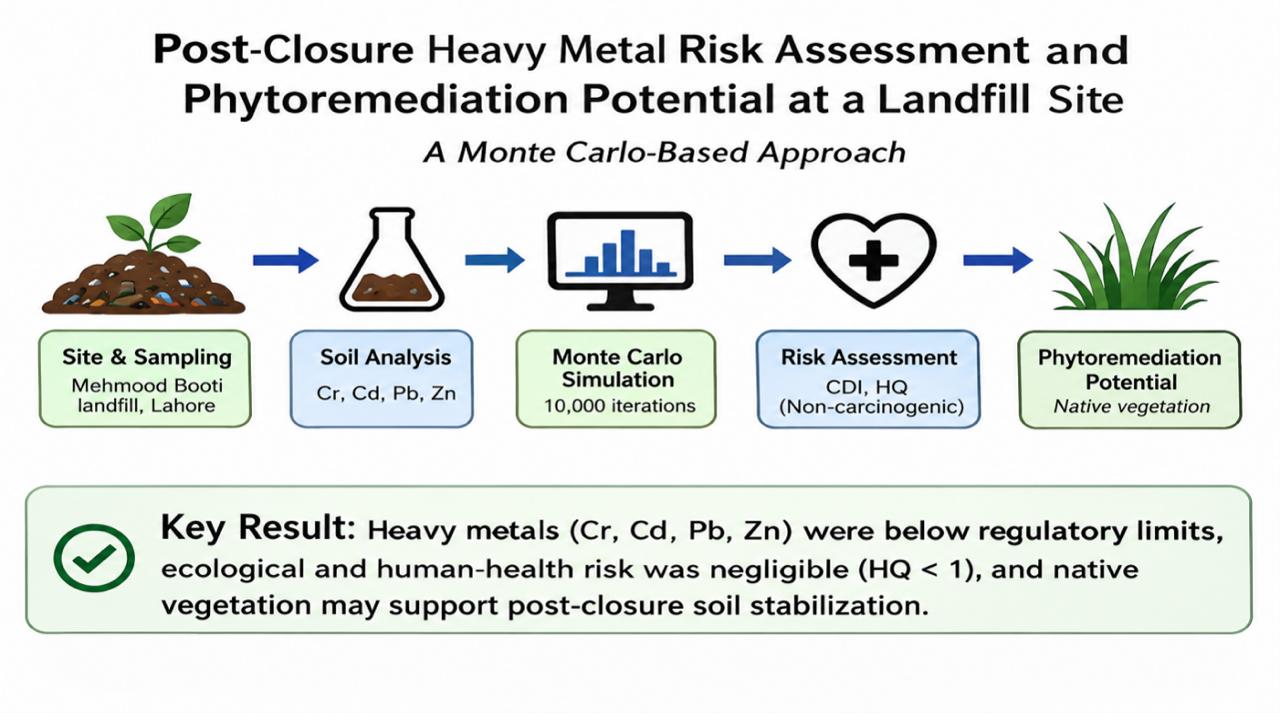
The uncontrolled disposal of municipal solid waste can leave residual heavy metals in soil after landfill closure. This study assessed near-surface soil quality and screening-level ecological and human-health risks at the post-closure Mehmood Booti landfill in Lahore, Pakistan. Five independent soil samples were collected from 1–3 ft depth and analyzed for chromium (Cr), cadmium (Cd), lead (Pb), and zinc (Zn), together with selected physicochemical properties. Zinc showed the highest reported mean concentration (8.46 ± 1.11 mg/kg), while Cd was below the reporting limit. The reported Cr and Pb readings are below the stated method detection limits and are therefore treated cautiously rather than as fully quantified concentrations. Regulatory screening comparisons indicated that Zn was below the selected PEQS screening value. The human-health assessment focused on the adult soil-ingestion pathway. An empirical Monte Carlo simulation of 10,000 iterations was constructed. The resulting Zn HQ distribution had P5 = 3.24 × 10⁻⁵, P50 = 3.74 × 10⁻⁵, and P95 = 4.50 × 10⁻⁵, and no simulated iteration exceeded HQ = 1. This is associated with the fact that the native phytoremediating species such as Chrysopogon zizanoides and Prosopis juliflora may provide natural stabilization of the heavy metals. The findings provide a screening-level assessment of the sampled near-surface soil and support continued monitoring of deeper soil, groundwater, and vegetation.