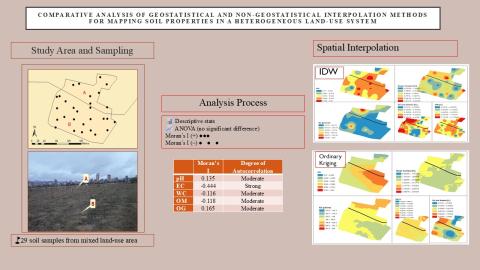
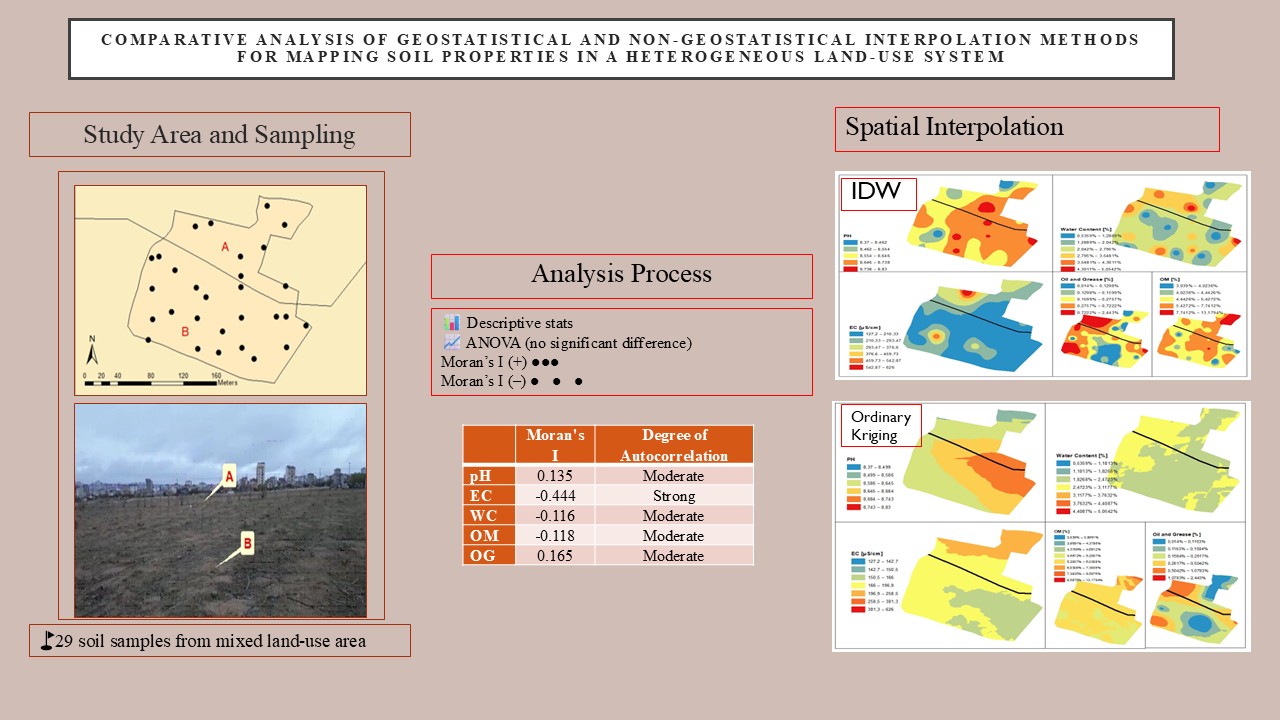
In this study, a mixed-use field that is close to downtown Niğde was chosen to test the performance of interpolation techniques. The traditional descriptive statistics were used to investigate if there were significant differences between the deforested and agricultural parts of the study area. A 3-ha area was chosen with 29 sample locations for analyzing spatial dependence and spatial interpolation. The parameters of soil pH, soil electrical conductivity (EC), organic matter (OM), water content (WC), and oil and grease (OG) were analyzed for 29 sample locations. The spatial autocorrelation was tested based on Moran’s I statistics, and positive spatial dependence was the highest for OG. Negative autocorrelation was estimated from soil EC. Also, a non-geostatistical interpolation technique called Inverse Distance Weighting (IDW) was used for the interpolation of soil properties throughout the study area. The performance of IDW was lowest for EC and highest for soil pH, soil oil, and grease. For geostatistical analysis, ordinary kriging (OK) interpolation was used for soil properties. Soil OM showed more precise results in OK than other soil properties. The one way ANOVA showed that the analyzed soil properties did not differ significantly between the agricultural and deforested sections of the study area.