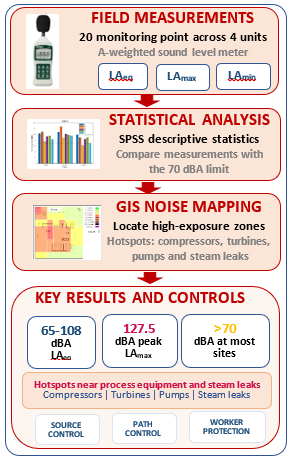
Industrial noise pollution poses significant occupational and environmental challenges in large petrochemical plants. This study presents an acoustic assessment and GIS-based spatial modelling of noise in the RA1K refinery, Skikda (Algeria). Field measurements using an A-weighted sound level meter were used to determine LAeq (equivalent continuous sound pressure level), LAmax (maximum sound pressure level), and LAmin (minimum sound pressure level) at multiple monitoring locations.
Results show that LAeq values ranged from approximately 65 to 108 dBA, with peak LAmax values reaching 127.5 dBA near compressors and pumps. Most monitoring points exceeded the Algerian regulatory limit of 70 dBA, indicating widespread occupational noise exposure across the refinery. High noise levels were mainly associated with compressors, turbines, pumps, and steam leakage zones.
GIS-based mapping identified strong spatial variability in noise distribution, highlighting localized high-risk areas within the industrial complex. A noise propagation model considering geometric attenuation, atmospheric absorption, and structural barriers was applied to interpret sound dispersion patterns.
The findings confirm the effectiveness of integrating field measurements and GIS techniques for industrial noise assessment and support the implementation of engineering control measures such as acoustic enclosures and silencers.