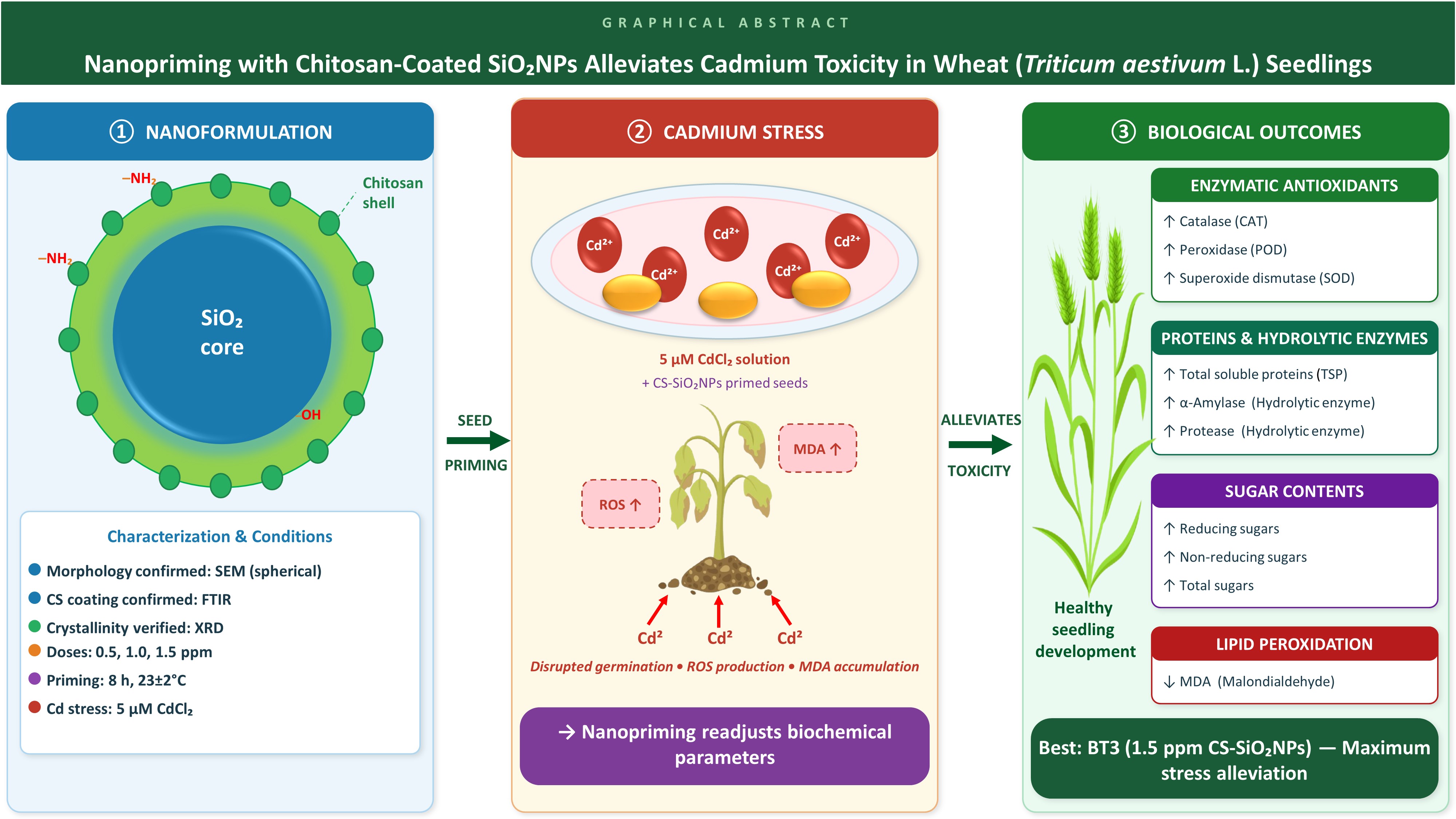
Heavy metals have become a major threat to the yield and grain quality of economically important cereal crops. Cadmium (Cd) is highly toxic and disrupts key physiological functions, biochemical processes, and cellular structures, retarding germination and seedling development. In recent years, SiO2NPs have shown promising applications in sustainable agriculture. In this study, chitosan (CS)-coated SiO2NPs were prepared and employed as the nanopriming agents to mitigate toxic effects of Cd in wheat seedlings. Nanopriming with CS-coated SiO2NPs readjusted the biochemical parameters, which counteracted Cd stress (5 µM) in wheat seedlings compared to the control. They significantly upregulated the hydrolytic enzymes (protease and α-amylase), and enzymatic antioxidants (CAT, POD and SOD). They also induced a significant increase in sugars (reducing sugars, non-reducing sugars, and total sugars) and total soluble proteins, alleviating the Cd toxicity in wheat seedlings. The activated antioxidant potential controlled ROS production, avoiding lipid peroxidation and reducing MDA content under Cd stress. The nanopriming-modulated biochemical attributes as a countermeasure of Cd toxicity, ensuring sustainable seedling development. The highest concentration of Cd (BT3; 1.5 ppm) caused the greatest overall biochemical response, resulting in a 51.7%, 49.5%, 49.8%, and 33.5% increase in TSP, CAT, POD, and SOD, respectively, compared to the non-primed control, but decreasing MDA by 20.1%. The responses were generally more pronounced in BT3 than the uncoated SiO2NP treatment (AT3), indicating the greater efficacy of chitosan coating on nanopriming response under Cd stress.