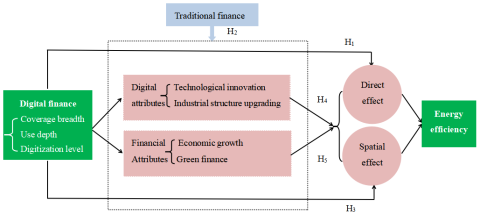
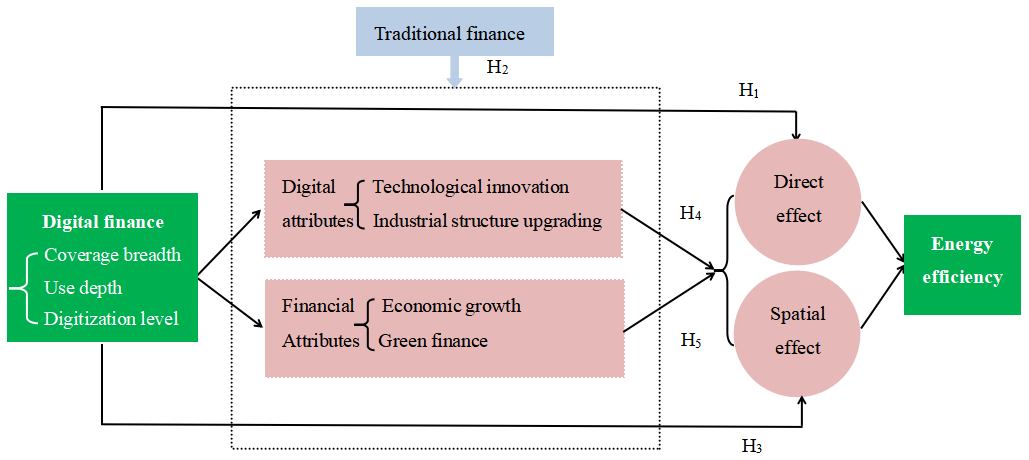
Building upon the moderating role of traditional finance (TF) and utilizing panel data from 30 Chinese provinces covering 2011-2023, this study employs a dynamic spatial Durbin model to examine the spatial spillover effects of digital finance (DF) on energy efficiency (EE) and their underlying mechanisms. The results show that DF directly enhances local EE and generates positive spatial spillovers in neighboring regions, exhibiting a time-lag effect that strengthens over time. Dimensional heterogeneity analysis reveals that DF usage depth contributes most substantially to EE improvement, followed by coverage breadth, while digitalization level has a weaker effect. TF exerts a significant positive moderating effect, with the strongest interaction on usage depth and the weakest on digitalization level. Mechanism tests confirm that DF improves EE in local and neighboring regions through four pathways: technological innovation, industrial upgrading, economic growth, and green finance development. However, only technological innovation transcends geographical constraints to generate multi-level spatial spillovers, whereas the other pathways demonstrate spatially localized containment effects.