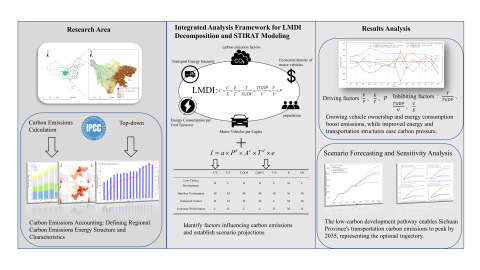
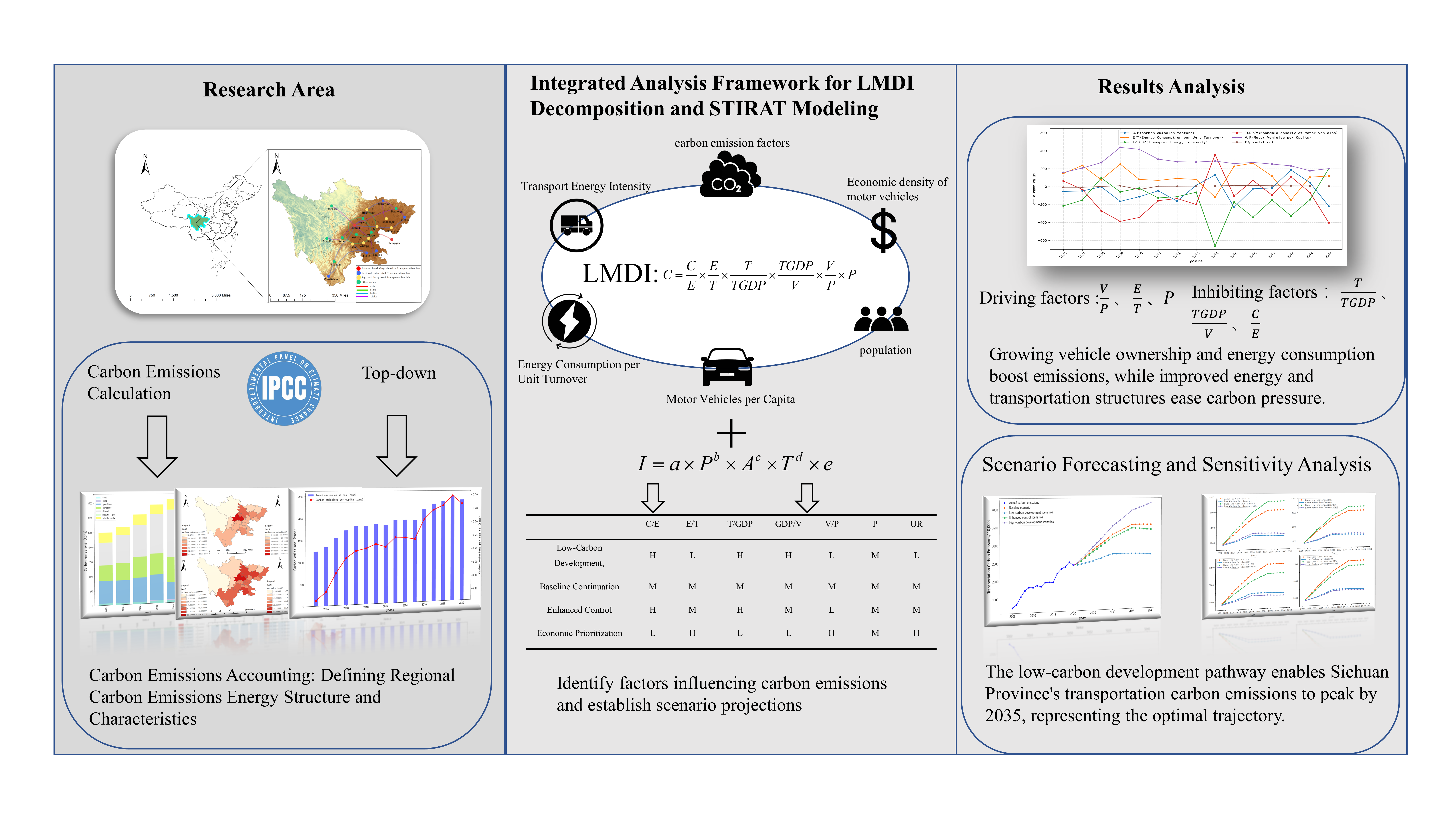
Transportation is a major contributor to carbon emissions, and achieving carbon peaking in this sector is essential for China’s Dual Carbon goals. This study investigates transportation carbon emission dynamics and future pathways in Sichuan Province, a representative western inland region with complex geographical and transport characteristics. A top-down carbon accounting approach was applied to estimate emissions during 2005–2020, while LMDI decomposition and an extended STIRPAT-based scenario framework were employed to analyze historical emission contributions and future trajectories under four scenarios. The results show that transportation carbon emissions increased from 12.47 million tons in 2005 to 24.02 million tons in 2020, with emission growth mainly associated with vehicle expansion and energy consumption, while improvements in energy structure and transport efficiency partially offset this trend. Scenario analysis shows that emissions peak around 2035 under both the Low-Carbon Development and Enhanced Control scenario, with the Low-Carbon Development scenario achieving a substantially lower peak level and stronger mitigation effect compared with other scenarios. The findings highlight the importance of region-specific strategies, including transport electrification, green urbanization, cleaner energy substitution, and low-carbon logistics development, for supporting transportation decarbonization in Sichuan and similar western inland regions.