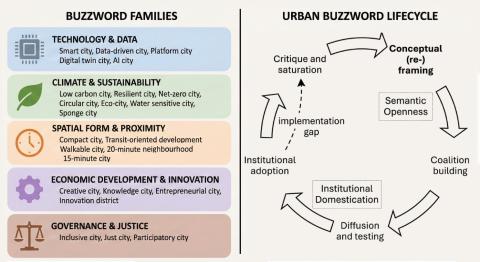
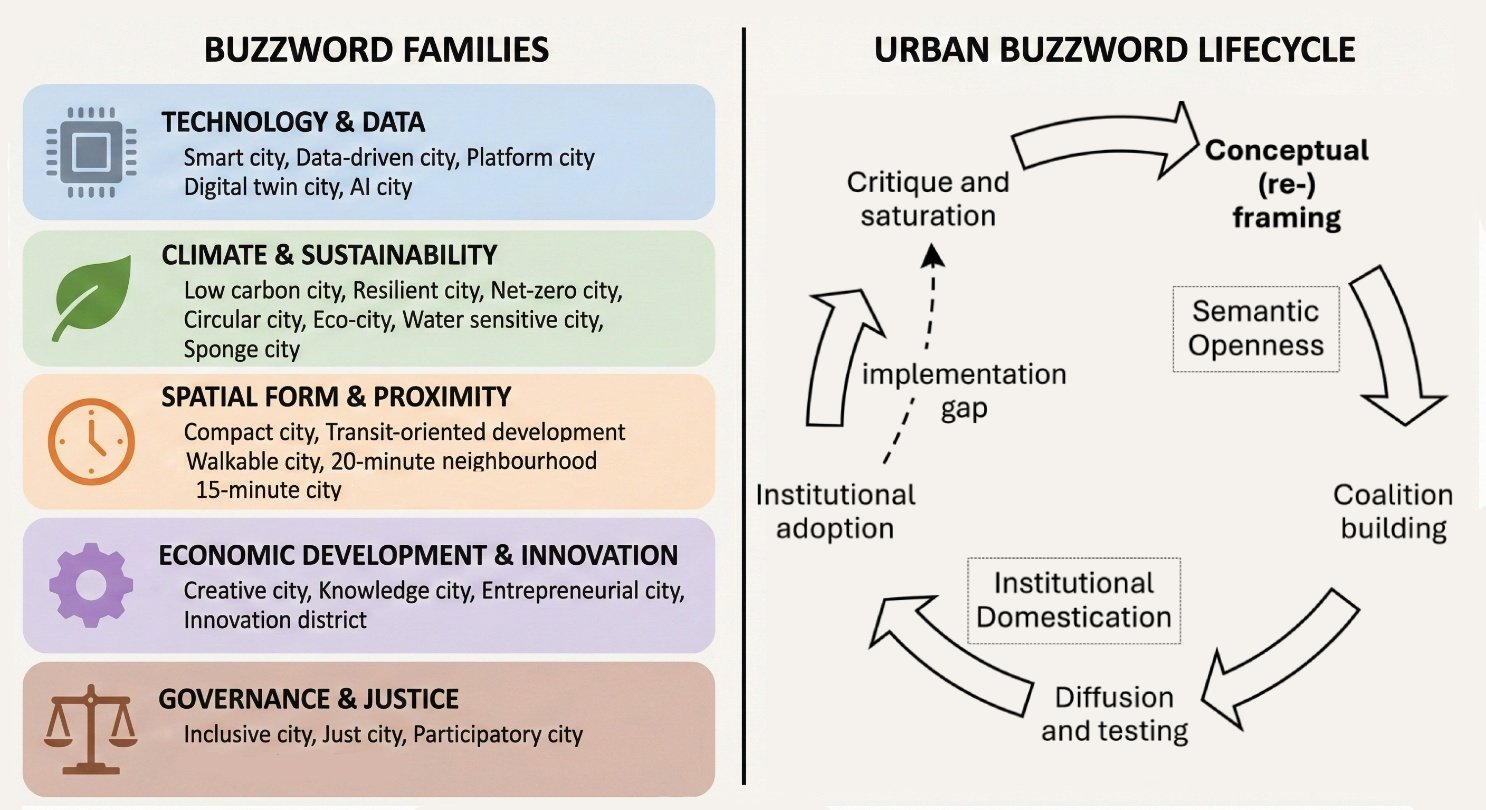
Over the past two decades, new terms have proliferated in urban planning discourse at an accelerating pace, often claiming to reframe how cities are understood, designed and governed. This article examines 24 widely used urban “buzzwords” as discursive devices, grouped into five thematic families: technology and data; climate and sustainability; spatial form and proximity; economic development and innovation; and governance and justice. Their propagation appears to depend on relatively open definitions, which allow adoption across institutional and professional contexts without prior consensus on objectives or instruments. New terms tend not to displace earlier ones but to layer onto them, producing cumulative planning vocabularies. The recurring patterns are interpreted through a five-stage lifecycle shaped by two cross-cutting properties: semantic openness during propagation and institutional domestication during adoption, the latter also potentially operating as a process of depoliticisation. The more productive direction for research lies less in refining definitions of emerging concepts than in examining how they shape attention, legitimacy and resource allocation within planning systems.