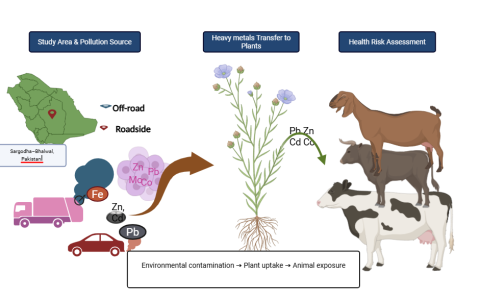
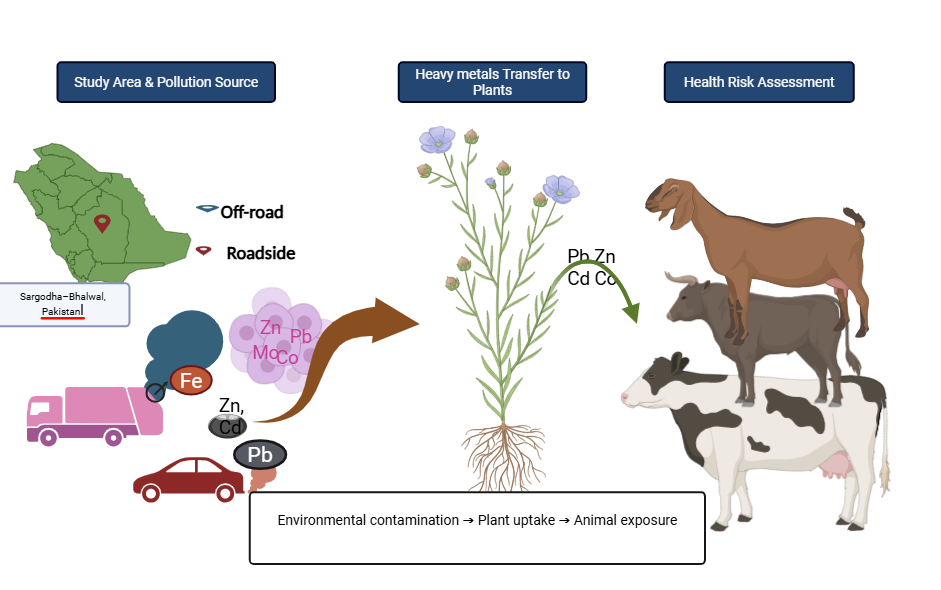
In this study, Linum usitatissimum L. (flax), a wild plant species predominantly growing in roadside habitats, is investigated with regard to contamination and accumulation of potentially toxic metals (PTMs). For this purpose, samples of soil and Linum were collected from Sargodha-Bhalwal road of Sargodha City. These samples of soil & plant were tested for the following HMs: Zn, Cu, Co, Mn, Mo, Fe, Pb, Cd using Flame Atomic Absorption Spectroscopy. Physico-chemical analysis of Bhalwal Roadside Locations (BRL) soils exhibited higher EC (11.42 dS/m), pH (7.8), organic matter (2.73 mg/kg), and PTM concentrations, with BRL1 showing maximum levels of Zn (30.88 mg/kg), Cu (17.16 mg/kg), Co (2.98 mg/kg), and Mn (97.94 mg/kg) than off-road sites. Linum samples also showed higher metal accumulation at Bhalwal Roadside Locations, with the highest Zn (33.48 mg/kg) and Fe (32 mg/kg) recorded at Bhalwal Roadside Location 1. Correlation analysis revealed strong positive relationships between Cd-Zn (r = 0.9992), Pb-Mn (r = 0.9789), and Zn-Cu (r = 0.9663), suggesting shared uptake mechanisms. Bioaccumulation factors were highest at Bhalwal Roadside Location 1, particularly for Co (0.37), Zn (1.08), and Cu (0.40), indicating greater metal uptake from roadside contamination. The present study reveals that the roadside vegetation, particularly L. usitatissimum L. has a great potential as bioindicator for the potentially toxic metals pollution in the urban environment. The findings enhance our understanding of soil-plant metal transfer mechanisms and serve as a foundation for the development of sustainable environmental monitoring strategies.