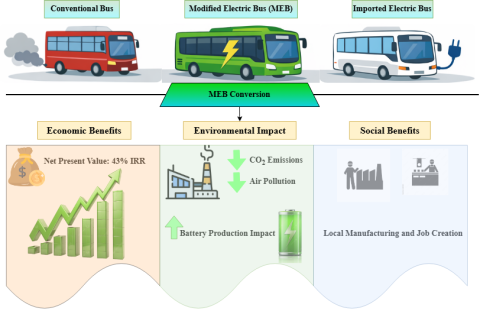
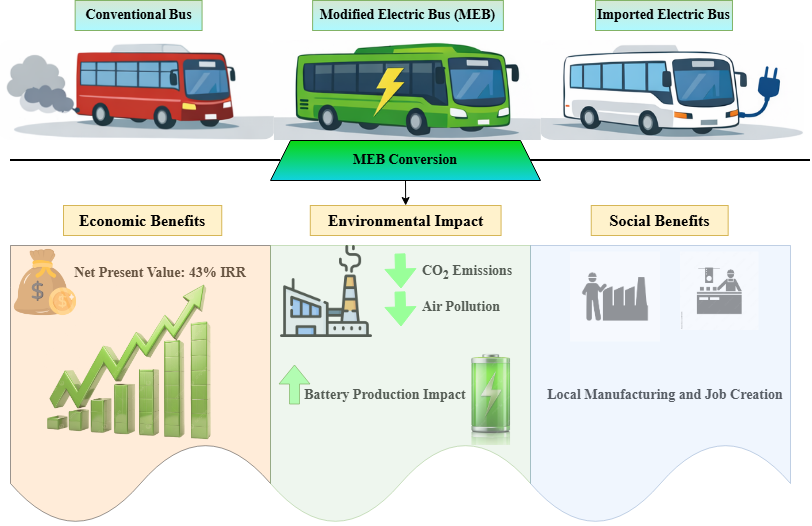
This study evaluates the feasibility of converting conventional diesel buses (CBs) operated by the Bangkok Mass Transit Authority into modified electric buses (MEBs) using a system dynamic modelling framework. The model integrates investment and operating costs, locally manufactured component costs, fuel and maintenance savings, job-creation and green-image benefits, and environmental impacts. Three options are compared over a 25-year horizon: continued operation of CBs, adoption of imported electric buses, and conversion of existing buses to MEBs. Simulation results show that the MEB program achieves a positive net present value and an internal rate of return that exceeds the government’s 12% benchmark, reaching about 43% at the end of the project, and outperforms the two alternatives economically. From an environmental perspective, replacing CBs with MEBs reduces operational CO2eq emissions and roadside particulate matter, while increasing one-time upstream metal-depletion and human-toxicity burdens associated with battery production. Overall, the integrated analysis indicates that a locally based MEB conversion strategy can be an economically attractive and environmentally beneficial pathway for accelerating bus electrification in Thailand, provided that supportive policies on local manufacturing, cleaner power generation, and battery recycling are implemented.